Key Takeaways
- There are no FDA-approved exosome products in the United States for any use. The FDA states this directly in a consumer alert that names exosomes.
- The reason is more fundamental than most articles admit. Federal regulation excludes “secreted or extracted human products” from the tissue-product category entirely, so the “361 compliant” shortcut clinics cite was never available for exosomes.
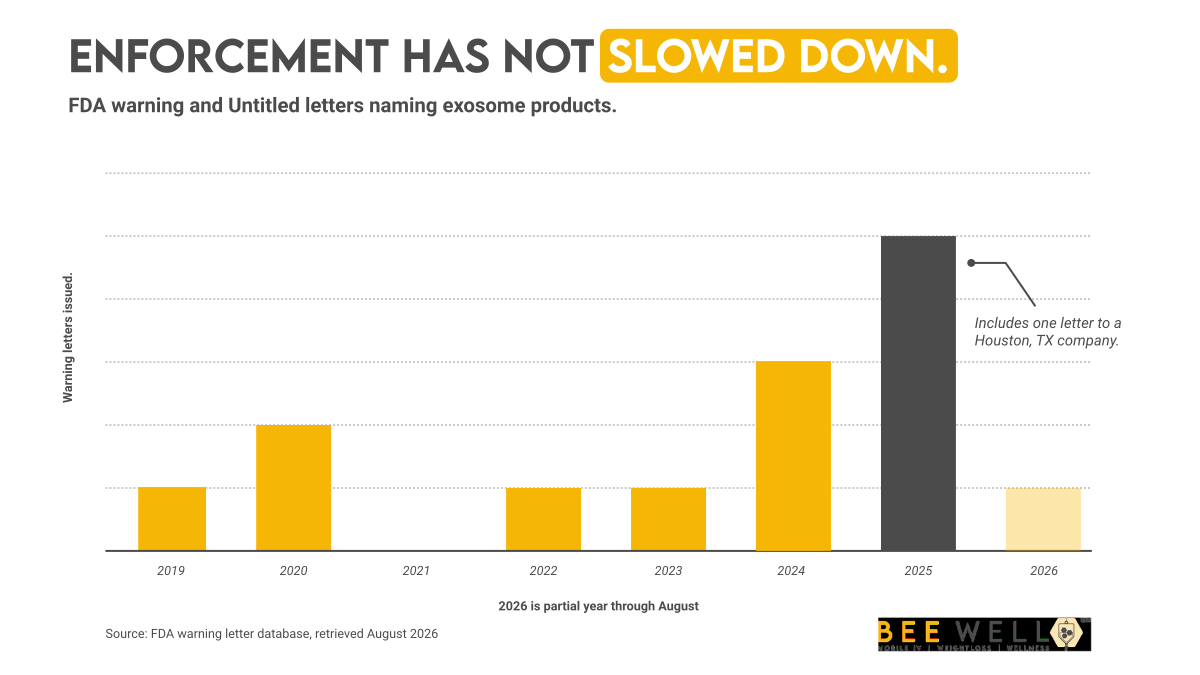
- Enforcement is current, not historical. The FDA has sent at least twelve warning letters naming exosome products since 2019, including one to a Houston company in May 2025.
- Documented harm in this category is real and Texas-heavy. A 2018 contaminated cord blood outbreak hospitalized 20 patients across eight states, seven to eight of them in Texas, and 54 percent of the tested product vials grew bacteria.
- Texas HB 810 does not authorize exosome therapy. It applies to adult stem cells administered inside an active clinical trial, and exosomes are not cells.
- One genuine Phase 3 exosome trial is enrolling in the United States, and it has sites in Dallas and Fort Worth. That is what a regulated pathway looks like.
There are no FDA-approved exosome products in the United States. Not for skin, not for hair, not for joints, not for fatigue, not for anything. The agency states it in one sentence on a page it maintains for consumers: “There are currently no FDA-approved exosome products.”
That sentence does not mean every provider offering exosome services is running a scam. It does mean the burden of checking has been handed to you, and that most of what you will read while you check is written by someone selling the thing.
So if a clinic in Dallas or Frisco tells you their exosome product is FDA-approved, stop there. If they tell you it is FDA-registered, ask what they mean, because registration is paperwork a company files about itself and the FDA’s own regulation says accepting that paperwork “does not constitute a determination that an establishment is in compliance with applicable rules and regulations or that the HCT/P is licensed or approved by FDA.”
The rest of this article is the long answer. It covers what the words actually mean, what the FDA has said and done, what has gone wrong for real patients, whether Texas law changes anything, and the seven questions worth asking before you hand anyone a credit card.
What “FDA-approved” actually means
Three terms get used interchangeably in wellness marketing, and a fourth shows up in the fine print. They describe completely different things, and the gap between them is where most of the confusion in this category lives.
Approved
Approval applies to drugs and biological products. A company submits evidence from clinical trials, and the FDA evaluates whether the benefits outweigh the risks for one specific use. In the agency’s own words, an approval means “a biological product is safe, pure, and potent.” Cell and gene therapies sit in this category. So do exosome products intended to treat anything.
Cleared
Clearance is a device pathway. A manufacturer shows its device is substantially equivalent to something already legally on the market. It is a lower bar, and it does not apply to exosome preparations at all. It does apply to some of the equipment used alongside them, which is where the language sometimes gets borrowed.
Registered or listed
A facility files a form telling the FDA it exists and what it makes. The FDA maintains a public database of these filings. The agency is unusually blunt about what that means: “Mere registration of an establishment or listing of a drug or device does not denote approval of the establishment, the drug or device, or other drugs or devices of the establishment, nor does it mean that a product may be legally marketed.”
On the device side the FDA goes further and states that firms displaying registration certificates “misbrand the device in violation of the Federal Food, Drug, and Cosmetic Act.” The agency also does not approve providers. There is no such thing as an FDA-approved clinic.
Investigational New Drug, or IND
An Investigational New Drug authorization, almost always shortened to IND, is permission from the FDA to study an unapproved product in people. Federal law requires a drug to have an approved marketing application before it moves across state lines, and an IND is the mechanism that exempts a sponsor from that requirement so a clinical trial can run.
That distinction does a lot of work in this article. An IND permits investigation. It does not permit sale, and it is not a step down from approval that a company can operate under while it charges patients.
What the FDA has actually approved in this space
The consumer alert is specific. The only FDA-approved stem cell products in the country are blood-forming stem cells derived from umbilical cord blood, approved for disorders affecting blood production. Everything else marketed under the regenerative banner sits outside that.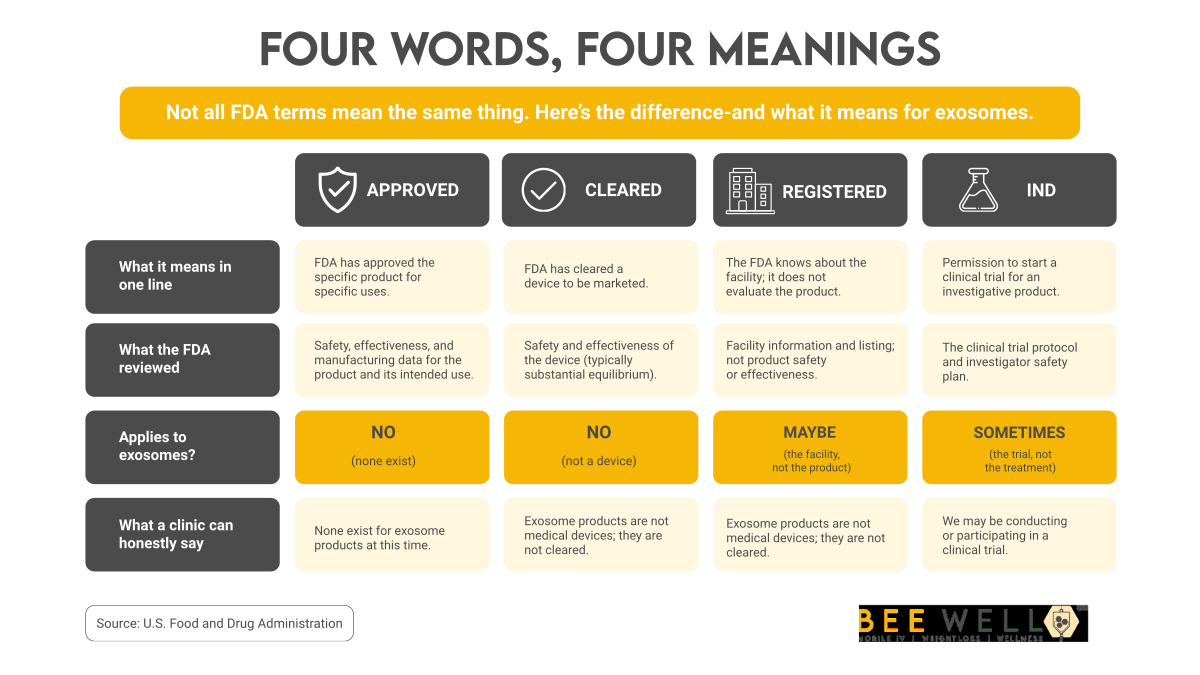
Why exosomes cannot take the “361” shortcut
This is the part almost nobody explains correctly, and it is worth two minutes of your time because it reframes the whole question.
There is a category in federal regulation called an HCT/P, short for human cells, tissues, and cellular and tissue-based products. Some HCT/Ps can be marketed without FDA approval under Section 361 of the Public Health Service Act if they meet four criteria: minimally manipulated, homologous use, not combined with another article, and no systemic effect. Clinics and suppliers lean on this constantly. You will see the phrase “361 compliant” on product sheets and consent forms.
Here is the problem. The regulation that defines an HCT/P also lists what is not one, and the list includes “secreted or extracted human products, such as milk, collagen, and cell factors.”
An exosome is a vesicle a cell secretes. It is a secreted human product by definition. So an exosome preparation is not an HCT/P at all, which means the four criteria never come into play and the 361 pathway was never open. Competitors who write that exosomes “fail the 361 criteria” have the right conclusion for the wrong reason. The door was not narrowly missed. It is a different building.
A 2026 review in Interventional Pain Medicine put it plainly, describing a cash-pay market “offering ‘361-compliant’ or ‘minimally manipulated’ exosomes for intradiscal, epidural, or joint injection, in direct conflict with FDA guidelines.”
If a provider or a product sheet describes an exosome preparation as “361 compliant,” that is not a gray area or an aggressive reading of the rules. It is a category error. Ask them to show you where in 21 CFR 1271 an exosome qualifies as an HCT/P. The honest answer is that it does not.
What the FDA has said, in its own words
The agency has published four separate consumer-facing documents on this since 2019. They are short, they are free, and they are worth reading before any appointment.
From the Public Safety Notification on Exosome Products, dated December 6, 2019:
From the agency’s patient and consumer information page on regenerative medicine therapies, updated in 2024:
That same page addresses the two moves patients most often encounter. Being shown a ClinicalTrials.gov listing, and being told a product is registered with the FDA. The agency’s response: “This is often false. The inclusion of a product in the clinicaltrials.gov database or the fact that a firm has registered with FDA and listed its product does not mean the product is legally marketed.”
The documented harms the FDA lists for this category are not abstract. They include blindness, tumor formation, neurological events, and “bacterial infections including life-threatening blood infections.”
As of May 2026 the agency’s warning page notes that it “continues to receive complaints or reports of adverse events involving such products, including patient deaths following their use.” The specific death referenced there involved an imported placental product rather than an exosome preparation, which is worth stating precisely rather than blurring. The posture is the point: this is a live enforcement priority in 2026, not a settled question from 2019.
Enforcement is current, and one letter went to Houston
Since 2019 the FDA has issued at least twelve warning letters and two untitled letters that name exosome products specifically. The pace has increased, not slowed.
| Year | Companies receiving letters naming exosome products |
|---|---|
| 2019 | Stemell Inc. (CA) |
| 2020 | Invitrx Therapeutics (CA) · EUCYT Laboratories (NV) |
| 2022 | Invitrx Therapeutics (CA), second letter |
| 2023 | Kimera Labs (FL) |
| 2024 | Evolutionary Biologics (NY) · plus untitled letters to Vitacell Biologics (TN) and Exocel Bio (CA) |
| 2025 | Chara Biologics (CA) · Supreme Rejuvenation (Houston, TX) · Platinum Biologics (FL) · Innate Healthcare Institute (AZ) · New Life Medical Services (FL) |
| 2026 | Dynamic Stem Cell Therapy (NV) |
The Houston letter, dated May 5, 2025, is the one Texas readers should look at. The FDA quoted the company’s own marketing back at it, including claims about fibromyalgia, insulin dependence, traumatic brain injury, glaucoma, and dementia. The company’s website carried a disclaimer saying the products were “for research and investigational purposes and are not approved for general medical use.” The FDA’s response to that defense was one sentence: “there is no IND in effect for your product. Nor is there a valid biologics license.”
What an inspection actually finds
The 2023 letter to Kimera Labs in Florida is the most detailed manufacturing record publicly available in this field, and it covers more than 37,000 vials made between April 2020 and June 2022. Among the ten cited deviations:
- The firm “failed to validate the aseptic processes” used to make products that “purport to be sterile and are expected to be sterile.”
- A positive sterility result on one lot was never investigated, and every vial of that lot was distributed.
- Sterility samples were frozen before testing, which the FDA noted “has the potential to destroy any microbial content in the samples before testing.”
- Product specifications were listed as “tentative.”
- Components labeled “For research use only” were incorporated into products injected into humans.
- A one-year expiration date was assigned “without adequate data regarding the stability characteristics of the products.”
Kimera actually held an active IND for one product at the time. The FDA cited them anyway, because an IND permits investigation, not sale. That distinction matters more than almost anything else in this article.
The rule most patients were never told changed
If you looked into regenerative medicine before about 2021 and formed an impression that the rules were loose, that impression had a basis. It is now out of date, and a surprising number of clinic websites have not caught up.
In November 2017 the FDA published a framework for regenerative medicine products and announced that for the next 36 months it would exercise enforcement discretion, under limited conditions, regarding the investigational new drug and premarket approval requirements for certain tissue products. That was a deliberate grace period to let a young industry come into compliance. It was extended once, and it ended on May 31, 2021.
The FDA published a question-and-answer page about what happens next, and the answers are short.
Asked whether a provider who had administered an unapproved product to a patient with a good response before May 31, 2021 could continue doing so, the agency answered: “No.”
Asked whether a sponsor holding an active IND could administer the same product to patients as treatment outside the trial, the agency answered: “No, even if you have an IND in effect, the unapproved product may not be administered as a treatment outside of the IND.”
And on the general position after that date: “If you market or offer for sale an HCT/P that requires premarket review as a drug and biological product, you do so at your own risk.”
During the discretion period the agency also said it would prioritize enforcement based on route of administration, singling out products “administered by intravenous injection or infusion, aerosol inhalation, intraocular injection, or injection or infusion into the central nervous system.” That list is worth reading twice if you have been offered an intravenous regenerative protocol.
Why PRP sits in a different box
Patients ask about this constantly, usually some version of “if exosomes are unapproved, how is PRP legal?”
The FDA answered it directly on that same page: “PRP is not an HCT/P because it is a blood product. Therefore, the compliance and enforcement policy did not apply to PRP.”
Platelet-rich plasma is made from your own blood during the visit, using devices that have been cleared by the FDA, and it is used off-label, which is legal standard practice across medicine. That is a genuinely different legal position from an allogeneic manufactured product marketed as a therapy. Neither is FDA-approved for hair loss or joint pain. Only one of them involves an unapproved biological product moving in interstate commerce.
That distinction is the single most commonly botched fact in this whole category, in both directions. Some clinics use it to imply exosomes are equally settled. Some critics use it to imply PRP is equally unproven. Neither is right.
The courts have weighed in twice
Two decisions matter if you want to know whether this is a live legal question or a settled one.
In June 2019 a federal judge in the Southern District of Florida granted summary judgment for the government against US Stem Cell Clinic and entered a permanent injunction, concluding that the defendants had adulterated and misbranded their cellular products.
In September 2024 the Ninth Circuit reversed a district court and upheld the FDA’s authority over a clinic administering stromal vascular fraction, treating the product as a drug. That decision, docket number 22-56014, is the most recent appellate word on the question.
The pattern across both is consistent. The argument that these products fall outside federal drug law because the material came from the patient, or because a state statute permits it, has not succeeded when tested.
None of which tells you whether a specific service will help you. It tells you the regulatory question is not genuinely unsettled, whatever a consent form implies.
What has actually gone wrong for patients
Risk in this category has less to do with the biology of exosomes and more to do with what happens between a lab and a syringe. The best-documented case is not an exosome product, but it is the clearest picture available of what a failure looks like, and Texas was at the center of it.
The 2018 cord blood outbreak
In late 2018 the CDC reported infections in 12 patients across three states after they received umbilical cord blood-derived products marketed as stem cell therapy. Seven of those 12 were in Texas. All 12 were hospitalized. None died.
The full investigation, published in JAMA Network Open in 2021, widened the picture considerably: 20 patients with culture-confirmed infections across eight states, with Texas again the largest group at eight. Nineteen of the 20 were hospitalized, for a median of nine days and as long as 58. Infections included bloodstream infections, septic arthritis, and epidural abscesses.
The product testing is the part worth sitting with. Investigators cultured 160 vials. Eighty-six of them, 54 percent, grew bacteria. Among vials still held by clinicians, 10 of 12 were contaminated. Sixteen different bacterial species were identified across the tested product.
A passing sterility report accompanied a contaminated vial. That sentence should change how you read any certificate you are handed.
The Texas Department of State Health Services issued its own advisory in April 2019, reporting eight Texas patients with bloodstream infections, joint infections, and epidural abscesses, and noting that the FDA’s inspection found the manufacturer “was not appropriately testing and screening umbilical cord blood donors for communicable diseases, such as HIV, hepatitis B, and hepatitis C.” The state recommended full medical assessment including HIV and hepatitis testing for everyone who had received the product.
The Nebraska exosome cluster
In December 2019, the FDA issued its exosome safety notification after “multiple recent reports of serious adverse events experienced by patients in Nebraska who were treated with unapproved products marketed as containing exosomes.” The Nebraska health advisory described patients who became ill after receiving “a product derived from C-section placentas, a subset of whom became bacteremic,” naming E. coli and Enterobacter cloacae.
Here is something you will not find on competing pages: no federal or state agency ever published a patient count, a product name, a manufacturer, or a clinic name for this cluster. Trade press reported at the time that state officials described fewer than five cases. Anyone citing a specific number is citing something that was never published.
Individual case reports, 2025
Two peer-reviewed reports from 2025 describe what goes wrong at the individual level. A case series in the Journal of Cosmetic Dermatology documented four women who developed persistent redness, nodules, granulomatous inflammation, and scarring after intradermal injection of exosome-containing products in a nonclinical setting. All four had incomplete resolution and residual scarring. A separate case report described a 38-year-old man who developed ischemic necrosis of both cheeks three days after an exosome injection for acne scars.
In both, the products had been intended for topical use and were injected instead. That is a handling and judgment failure, not a biology failure, which is the recurring theme of this whole section.
“But isn’t this legal in Texas?”
We get this question at nearly every regenerative consultation, usually phrased as “I heard Texas has a law.” Texas does. Two, actually. Neither one does what people think.
HB 810, known as Charlie’s Law
Passed in 2017 and codified in Chapter 1003 of the Health and Safety Code, HB 810 widened access to certain investigational treatments for seriously ill Texans. Its defined term is the whole ballgame:
Two things follow. Exosomes are not adult stem cells; they contain no cells at all. And the treatment has to be happening inside an active clinical trial, not sold as a service. The law also requires a severe chronic disease or terminal illness, institutional review board oversight, and administration at a licensed hospital, a licensed ambulatory surgical center, or a medical school.
HB 810 does not mention exosomes anywhere. It does not authorize exosome therapy, and a wellness clinic offering an exosome infusion is not operating under it.
SB 773, the 2023 Medical Freedom Act
This one comes up more often now. It extended Texas right-to-try provisions to severe chronic disease. It also contains two requirements that make it useless as cover for a commercial clinic. The product must have completed Phase 1 of a clinical trial and still be under investigation in that trial. And the manufacturer must provide it to the patient “without receiving compensation.”
A clinic charging several thousand dollars for an infusion is outside that statute on its face.
The larger point
State law cannot authorize what federal law prohibits. The FDA regulates exosome products under the Federal Food, Drug, and Cosmetic Act and the Public Health Service Act, and the Ninth Circuit reaffirmed the agency’s authority over this category in September 2024. Texas law provides narrow protection from state medical board discipline in specific circumstances. It creates no federal safe harbor.
What a real trial looks like, and one is enrolling in Dallas and Fort Worth
It would be easy to read this far and conclude the whole field is theater. It isn’t. There is a regulated pathway, companies are on it, and one of them is recruiting in your city.
Direct Biologics is running EXTINGUISH ARDS, a Phase 3 trial of bone marrow mesenchymal stem cell-derived extracellular vesicles in hospitalized patients with moderate to severe acute respiratory distress syndrome. Registration number NCT05354141. Target enrollment 970 patients across 32 sites. Started July 2022, primary completion scheduled for November 2027, record last updated February 2026. Three of the sites are in Texas: Dallas, Fort Worth, and Houston.
Notice what that looks like from the outside. A registered protocol. A specific indication with a hard endpoint. Nearly a thousand patients. Five years. Hospital settings. No charge to participants.
Notice also what it is not. It is not a wellness infusion, and the product has neither a biologics license nor FDA approval. That company has ten registered studies; three were terminated and four were withdrawn. That is what real development looks like, and it is the reason approval means something.
Why a ClinicalTrials.gov listing proves nothing
As of August 2026 a search of ClinicalTrials.gov returns 596 records mentioning exosomes. Ninety-five are interventional studies with US locations. Exactly three of those are labeled Phase 3, and only one is a genuine exosome therapeutic. One of the others is a prostate cancer imaging study. The third is a 20-patient skin rejuvenation study sponsored by a skincare company that self-assigned the Phase 3 label.
Anyone can register a study and choose their own phase designation. That is precisely why the FDA warns that inclusion in the database “does not mean the product is legally marketed.” If a clinic shows you a registry printout, the question to ask is whether you are being enrolled in that trial, at no charge, with informed consent and IRB oversight. If the answer is no, the printout is decoration.
Seven questions to ask any exosome provider
Bring these to any consultation in the metroplex, ours included. The answers will sort providers faster than price or website design ever will.
- Who manufactures the product, and will you show me the certificate of analysis for the lot you are using on me? A provider who cannot name the lab has not checked.
- Was this lot tested for sterility and endotoxins, and by which laboratory? Ask to see the result, and remember that a passing report has accompanied contaminated product before.
- Do you have an IND number for this product? The FDA specifically tells patients to ask for it, along with a copy of the FDA communication acknowledging the IND. The agency cannot confirm an IND exists, so the sponsor has to show you.
- Who is administering it, and what license do they hold? In Texas you can verify a nursing or medical license online in about ninety seconds.
- Which physician is overseeing my care, and can I speak with them before the appointment? Oversight that exists only on a website is not oversight.
- What will you put in writing about what I should expect? This is the question that separates practices.
- What happens if I have a reaction, who provides that care, and who pays for it? The International Society for Stem Cell Research puts this on its patient checklist for good reason.
THE TELL THAT MATTERS MOST
Any provider willing to guarantee you a specific outcome from a product with no approved indication has told you something about their judgment, and it is not flattering.
The honest answer to “what will this do for me” involves ranges, uncertainty, and an assessment of whether you are a reasonable candidate at all. If you get a promise instead, you have your answer about the practice.
How the market talks about its own regulatory status
There is peer-reviewed research on exactly this, and it is more useful than any anecdote.
A research team led by Leigh Turner at UC Irvine has published several analyses of direct-to-consumer marketing by US businesses selling stem cell and exosome products. In one 2023 study analyzing 978 such businesses, the finding was that “more than two thirds of such businesses did not make explicit representations about the regulatory status of their marketed products.”
Not misrepresented. Did not mention it at all.
A companion study found that fewer than half made identifiable claims about safety and efficacy either. The pattern is not aggressive overclaiming so much as strategic silence, which is harder to spot and harder to challenge.
A third study in Stem Cell Reports looked at 38 businesses marketing these products for COVID-19, operating or facilitating access to 60 clinics. The least expensive product cost $2,950, the most expensive $25,000, and the average listed cost was $11,322.
Nobody publishes a reliable count of how many US clinics currently offer exosome services. Estimates circulate, and the most-cited figure traces to a technology magazine rather than to a peer-reviewed source. What is documented is that one vendor described being in “a little less than a thousand medspas, aesthetician offices, dermatologists, plastic surgeons.”
When you are evaluating a provider, absence of regulatory language on a website is information. It is the most common pattern in the category.
What to do if you have already had treatment
A fair number of people find articles like this one after the fact. If that is you, three things are worth doing and none of them require alarm.
- Ask the practice for your records, including the product name, manufacturer, lot number, and any certificate of analysis. You are entitled to your own treatment record. Keep it.
- Watch for delayed symptoms. The documented harms in this category are largely infectious. Fever, spreading redness, worsening pain at an injection site, joint swelling, or new back pain after a spinal injection all warrant prompt medical attention. Tell whoever sees you exactly what you received and when.
- Report an adverse reaction. The FDA’s MedWatch program accepts reports directly from patients. Reporting in this category is known to be incomplete, which is part of why the safety picture stays murky, so an individual report is more valuable than it feels.
If nothing went wrong, nothing needs to be done. Most people who receive these products do not develop an infection. The point of knowing what you received is that it costs nothing now and matters enormously if a question comes up in two years.
How Bee Well℠ handles this
We deliver regenerative wellness services at homes and offices across Dallas, Fort Worth, Frisco, Denton, Southern Oklahoma, and parts of California, and this question comes up constantly. Our position has not changed since we started offering these services: we tell people the category is not FDA-approved before they think to ask.
Practically, that means a few things. Every service is administered by a licensed nurse under Texas-licensed physician oversight. We are LegitScript Healthcare Merchant Certified, which involves independent review of our licensure and operating practices. We will name our manufacturer and provide a lot of documentation on request, before your appointment rather than after. And we do not tell patients what their results will be, because nobody can do that honestly for a product in this category.
We would rather lose a booking to a straight answer than win one on a promise we cannot keep. If you are weighing exosome therapy and you want a conversation that starts with what is actually known, that is the conversation we prefer to have anyway.
References
- U.S. Food and Drug Administration. Consumer Alert on Regenerative Medicine Products Including Stem Cells and Exosomes. Content current as of April 9, 2024. fda.gov
- U.S. Food and Drug Administration. Public Safety Notification on Exosome Products. December 6, 2019. fda.gov
- U.S. Food and Drug Administration. Important Patient and Consumer Information About Regenerative Medicine Therapies. Content current as of April 8, 2024. fda.gov
- U.S. Food and Drug Administration. Is It Really “FDA Approved”? Consumer Updates. fda.gov
- 21 CFR 1271.3(d)(3) and 21 CFR 1271.10(a). Electronic Code of Federal Regulations. ecfr.gov
- 21 CFR 1271.27(b). Registration number assignment. ecfr.gov
- Perkins KM, Spoto S, Rankin DA, et al. Notes from the Field: Infections After Receipt of Bacterially Contaminated Umbilical Cord Blood-Derived Stem Cell Products. MMWR Morb Mortal Wkly Rep. 2018;67(50):1397-1399.
- Hartnett KP, Powell KM, Rankin D, et al. Investigation of Bacterial Infections Among Patients Treated With Umbilical Cord Blood-Derived Products Marketed as Stem Cell Therapies. JAMA Netw Open. 2021;4(10):e2128615.
- Texas Department of State Health Services. Health Advisory: Bacterial Infections Associated with Stem Cell Products. April 26, 2019. dshs.texas.gov
- Texas Health and Safety Code Chapter 1003, Subchapter B (HB 810, 85th Legislature, 2017); Texas Health and Safety Code Chapter 490 (SB 773, 88th Legislature, 2023).
- U.S. Food and Drug Administration. Warning Letter, Supreme Rejuvenation LLC, Houston TX. May 5, 2025; Warning Letter, Kimera Labs Inc. September 1, 2023. fda.gov
- Bourcier AJ, Kirkor ZM. Regulatory, ethical, and clinical barriers to exosome use in interventional pain medicine. Interventional Pain Medicine. 2026;5(1):100746.
- Park KY. Adverse Reactions Following Intradermal Injection of Exosome-Based Formulations: A Case Series. J Cosmet Dermatol. 2025;24(10):e70520.
- ClinicalTrials.gov. NCT05354141, EXTINGUISH ARDS. Record updated February 23, 2026.
DISCLAIMER:
This content is for educational purposes only and does not constitute medical advice. It is not a substitute for consultation with a qualified healthcare provider. No exosome product is approved by the U.S. Food and Drug Administration, and individual results cannot be predicted or guaranteed.
If you develop fever, spreading redness, worsening pain, or difficulty breathing after any injection or infusion, seek emergency care immediately rather than waiting to reach the practice that treated you.
Call 911 for a medical emergency.