Key Takeaways
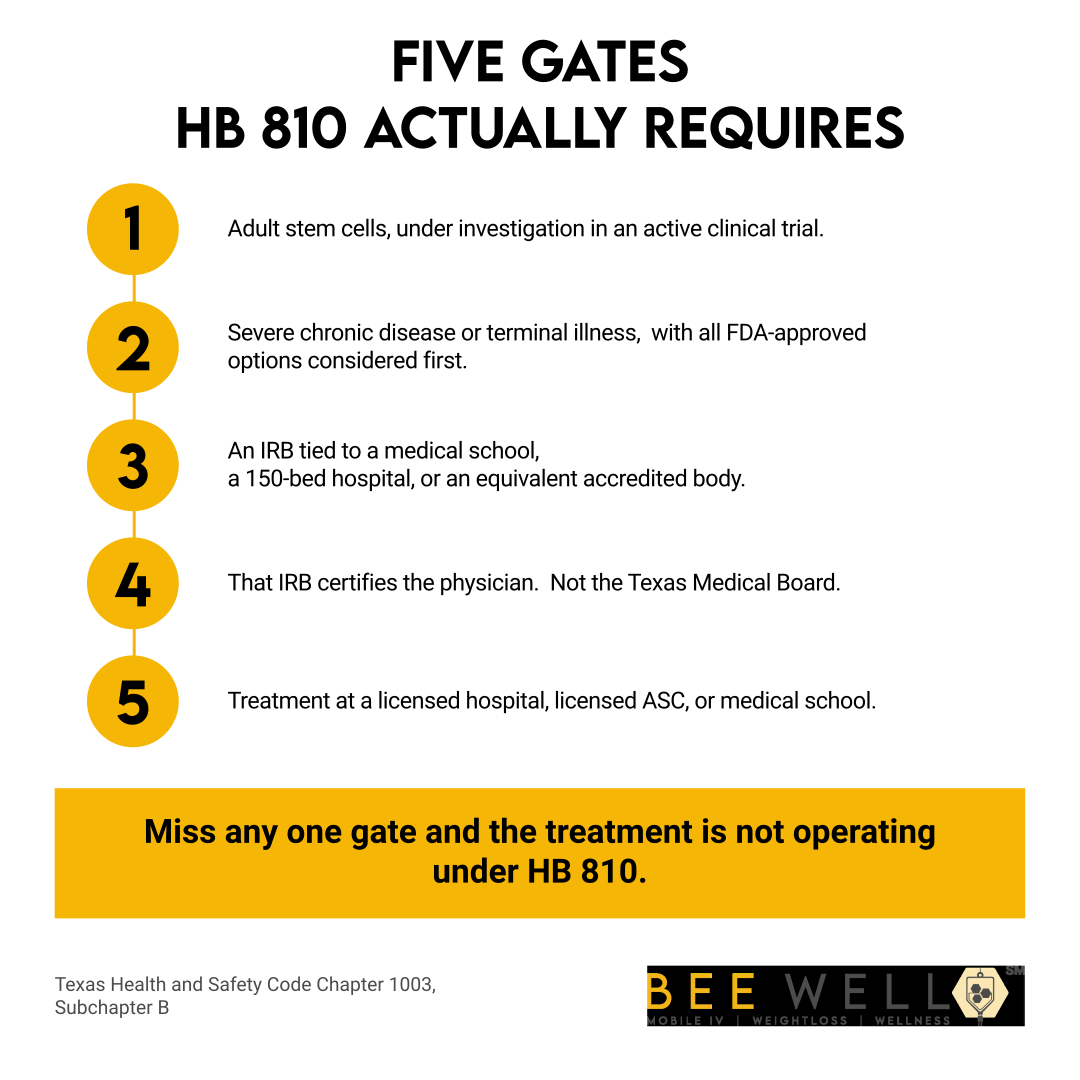
- Texas HB 810, known as Charlie’s Law, is real. It applies to adult stem cell treatments given inside an active clinical trial, to patients with a severe chronic disease or terminal illness, under an institutional review board tied to a medical school or a hospital of at least 150 beds.
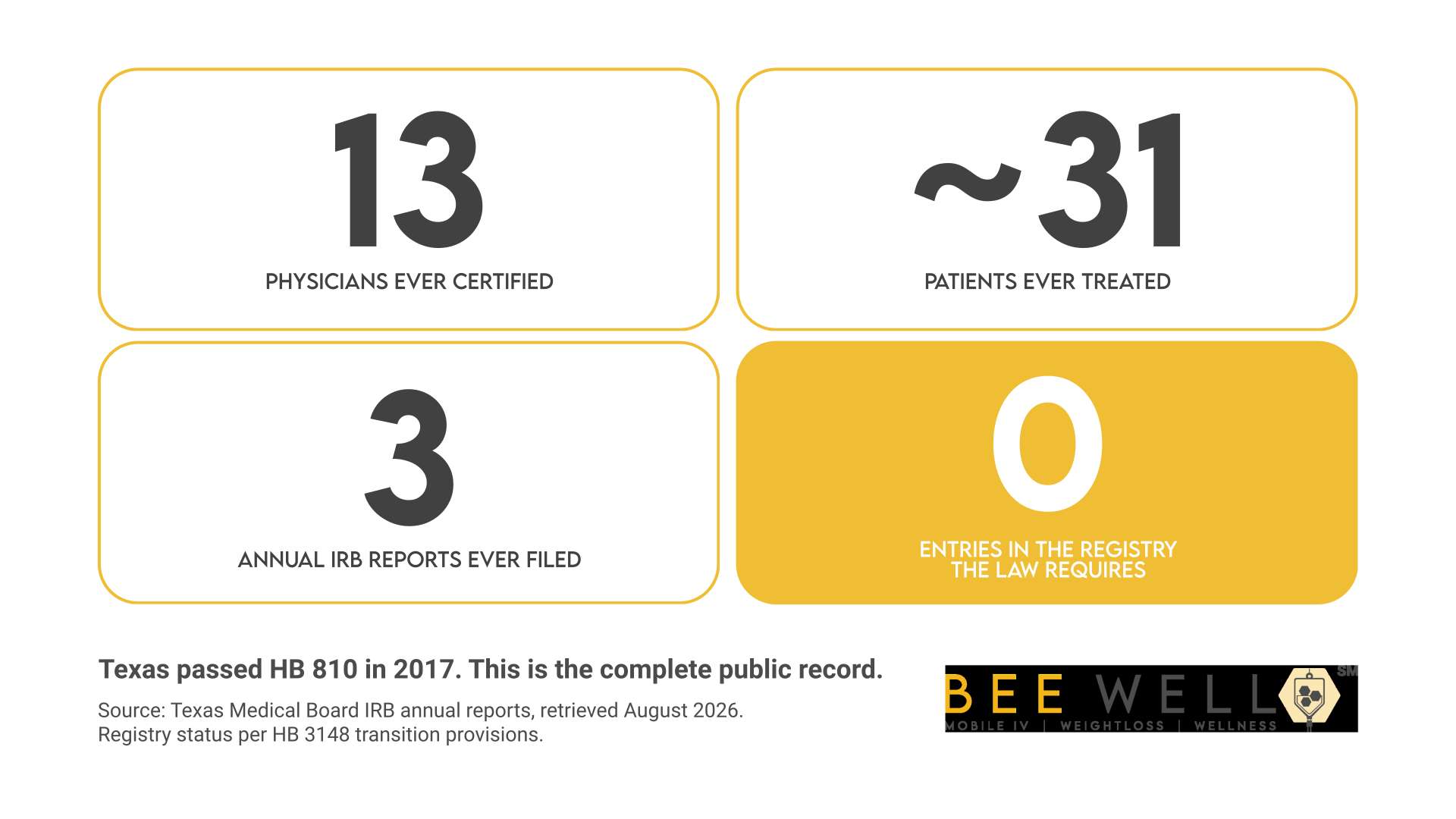
- We pulled every IRB annual report the Texas Medical Board has ever posted. In nine years the entire documented universe under this law is 13 physicians certified and roughly 31 patients treated, across three reports, with a four-year filing gap from 2020 to 2023.
- The registry the law requires does not exist. The Legislature affirmatively barred the state health department from building it until September 1, 2027.
- Exactly one Dallas-Fort Worth location ever appears in the record, in Allen, and those certifications lapsed in 2020.
- Almost every DFW clinic marketing stem cell services is not operating under HB 810. Most do not mention it. The ones that do generally are not meeting its requirements, because if they were, their IRB would appear in the Medical Board’s filings.
- State law cannot authorize what federal law prohibits. The Ninth Circuit reaffirmed FDA authority over these products in September 2024, and the Supreme Court declined to hear the appeal in October 2025.
Texas has a stem cell law. It does not do what most people are told it does.
HB 810 created a narrow pathway for seriously ill Texans to receive adult stem cell treatments that are already being studied in a clinical trial. It requires a qualifying diagnosis, an institutional review board affiliated with a medical school or a large hospital, physician certification by that board, enrollment in a trial, and administration at a licensed hospital, a licensed ambulatory surgical center, or a medical school.
It is not a general permission slip for a wellness clinic to sell you an infusion.
We know how many people have actually been treated under it, because the law requires reporting and we went and read the reports. The number is 31.
What the law says, in its own words
HB 810 passed the 85th Legislature in 2017 and was codified in Chapter 1003 of the Texas Health and Safety Code. It is commonly called Charlie’s Law.
The definition is the whole thing:
Read that twice. Two conditions, both required. The treatment must use adult stem cells, and it must be happening inside a clinical trial that is actively enrolling human participants.
A service you pay for, delivered outside a trial, is not an investigational stem cell treatment as this statute defines it. Whatever else that service may be, it is not operating under HB 810.
Who qualifies as a patient
The law requires a severe chronic disease or terminal illness, attested by the treating physician, who must first have considered all other treatment options currently approved by the FDA.
The state health department adopted definitions rather than a list. Under 25 Texas Administrative Code section 1.461, a severe chronic disease is “a condition, injury, or illness that may be treated, is never cured or eliminated, and entails significant functional impairment or severe pain.”
That is broad. Osteoarthritis fits. Degenerative disc disease fits. Chronic joint pain fits. There is no gatekeeping list of qualifying diagnoses, and this is worth being honest about, because the narrowing work in this statute is done somewhere else entirely.
Where the narrowing actually happens
Four requirements do the real filtering, and they are the ones nobody mentions in marketing copy.
- An institutional review board must oversee the treatment, and not any board will do. It must be affiliated with a medical school, or with a hospital of at least 150 beds, or hold AAHRPP accreditation, or be registered with the federal Office for Human Research Protections, or be accredited by a national organization the Texas Medical Board finds acceptable.
- That IRB must certify the physician. The Texas Medical Board does not do the certifying. The board does.
- The patient must be enrolled in the clinical trial, not merely treated with something similar to what a trial is studying.
- Treatment must occur at a qualifying facility: a hospital licensed under Chapter 241, an ambulatory surgical center licensed under Chapter 243, or a medical school.
A home visit does not qualify. A medical spa does not qualify. An office-based clinic does not qualify.
What nine years of records actually show
Here is where this article has something no other page has.
The law requires each certifying IRB to file an annual report with the Texas Medical Board, and those reports must name every physician certified, the treatments provided, the number of patients, and the outcomes. The Medical Board posts them publicly. Each form carries a notice reading: the information is publicly available.
We retrieved and read every report the Board has ever posted. There are three.
| Report | Period | Physicians certified | Patients |
|---|---|---|---|
| Advarra IRB, affiliated with Memorial Hermann and UTHealth McGovern Medical School | Sept 2018 to Aug 2019 | 6 | 11, all osteoarthritis |
| UTHealth Houston Committee for the Protection of Human Subjects | FY 2023 to 2024 | 7 | 6 enrolled and randomized |
| UTHealth Houston Committee for the Protection of Human Subjects | FY 2024 to 2025 | 7 | 20 enrolled and randomized |
The Medical Board’s own page states plainly that there are no reports from 2020 through 2023. A four-year gap in mandatory annual filings, with no apparent consequence.
Total across the entire history of the law: 13 physicians certified, roughly 31 patients treated.
What those patients actually received
The 2019 Advarra report covers 11 patients treated for osteoarthritis of the knee, hip, shoulder, and thumb, aged 46 to 87. Outcomes were self-reported as greatly or somewhat improved. No control group, no blinding, follow-up ranging from ten days to six months. All six physician certifications expired in May or August of 2020 and were not renewed.
The two UTHealth reports cover a single study: autologous adipose-derived mesenchymal stem cells for chronic traumatic brain injury, registration NCT05951777. It is a Phase 2 trial with a placebo arm, sponsored by a biotechnology company, running under an FDA investigational new drug authorization at Memorial Hermann in Houston and UT Health San Antonio.
That trial would be lawful in any state in the country. HB 810 added nothing to it.
The registry that does not exist
In 2019 the Legislature amended the law through HB 3148 and added a requirement that reads, in the codified text, as a mandate:
There is no registry. There is no physician list, no reporting portal, no public record of who is administering these treatments in Texas.
The reason sits in a transition section of the same bill, uncodified, which means it is invisible to anyone reading only the statute. Its language is worth quoting exactly:
Not “is not required to.” May not. The Legislature affirmatively prohibited the state from building the registry for eight years.
So as of August 2026, nine years after the law passed and seven years after the registry was mandated, Texas has no public accounting of who is delivering investigational stem cell treatments or how those patients did. The prohibition lifts in September 2027.
For context on whether this is normal: the state health department operates registries for cancer, immunizations, birth defects, and bone marrow donation. The absence of a stem cell registry is a policy choice, not an oversight.
WHY THIS MATTERS TO PATIENTS, NOT ONLY TO POLICY PEOPLE
The Baker Institute at Rice University has published two analyses of this law. Its 2022 piece noted the reporting start date was pushed from 2019 to 2027 and cited estimates that nearly half of patients undergoing stem cell interventions gain no benefit or experience negative effects.
No published analysis concludes HB 810 has helped patients. None could. The outcome data the law was designed to generate does not exist, because the mechanism for collecting it was switched off for eight years.
When a clinic tells you Texas law supports what they are selling, the honest follow-up is: then where is the reporting?
How Dallas-Fort Worth clinics actually talk about this law
We looked at how Texas clinics describe HB 810 on their own websites. The pattern is more interesting than a simple accusation of misuse, and it breaks into three tiers.
Some name the law and let the reader connect it. They cite HB 810 and Charlie’s Law accurately, then discuss orthopedic and anti-aging services in adjacent copy, without ever stating that those services are provided under the law. Nothing false is said. The inference does the work.
Some name it carefully. One Fort Worth page frames HB 810 as imposing requirements rather than granting permission, and even flags the federal appellate ruling. That is accurate and rare.
Most say “Texas law allows” with no citation at all. No bill number, no eligibility criteria, no mention of IRB oversight or clinical trial enrollment. One national page misattributes the governing authority to a 2025 statute that concerns individualized investigational treatments and has nothing to do with Chapter 1003.
The largest clinics do not cite it at all
Here is the finding that surprised us most. The biggest stem cell practices in the metroplex, including one advertising treatment for more than thirty conditions ranging from Parkinson’s to autism to macular degeneration, do not mention HB 810 anywhere. They rest instead on the phrase “IRB reviewed protocols.”
Those are not the same thing, and the difference is checkable. A commercial IRB reviewing a network protocol satisfies none of HB 810’s reporting obligations. If a DFW clinic were genuinely operating under the law, its IRB would appear in the Texas Medical Board’s annual filings.
None do. Exactly one DFW-area address appears anywhere in the record: a pain clinic in Allen, listed in the 2019 Advarra report, whose physician certification expired in 2020.
The Baker Institute has a phrase for this pattern. It calls citations like these “tokens of legitimacy,” deployed to imply an approval that does not exist. Invoking HB 810 in marketing is itself a token of legitimacy.
What Charlie’s Law was actually for
It is worth understanding the intent, because the gap between the intent and the outcome is the real story here and it is not a story about bad faith.
The law was named for a patient, and it emerged from a genuine and sympathetic problem: people with severe chronic and terminal conditions who had exhausted approved options and could not get into a clinical trial. That is a real category of person, and Texas is not the only state that has tried to legislate for them.
The legislative approach was to loosen the state-level constraints while leaving the federal ones untouched, which is the same design used in right-to-try laws. It shields a physician from state medical board discipline in specific circumstances. It does not and cannot create an exemption from federal drug law.
Analysis from the Baker Institute at Rice University placed HB 810 in that deregulatory lineage from the start. Its 2018 assessment raised the concern that has since proved accurate: clinics worldwide were selling stem cell interventions that had not been proven safe or effective, with little or no accounting of the outcomes being collected.
The accounting was the part the law was supposed to fix. The 2019 amendment added a registry and an annual reporting duty precisely so Texas would know what was happening. Then the same bill prohibited the registry from being built for eight years.
The Baker Institute’s 2022 follow-up made three recommendations: in-clinic disclaimers that these interventions are experimental, disclaimers on all advertising noting the absence of FDA approval, and mandatory adverse event reporting to Texas medical boards. None has been adopted.
The result is a law that is genuinely narrow in what it permits, essentially unused by the people it was written for, and widely invoked by businesses that are not operating under it.
The consent form Texas actually wrote
One part of the law did get implemented, and it is useful to you as a benchmark.
The Department of State Health Services adopted a mandatory informed consent form for investigational stem cell treatments, effective January 2021. It is a public document available on the department’s website.
What matters is what it requires a patient to be told. Among other things, it states that the treatment has not been approved for general use by the FDA.
So Texas has an official position on what a patient receiving an investigational stem cell treatment must be told, and that position includes a plain statement that the product is not FDA-approved.
Use it as a floor. If a clinic anywhere in the metroplex is offering you a stem cell service and the consent document you sign does not clearly say the product is not FDA-approved, the disclosure you are receiving is thinner than what the state requires in the one context it directly regulates.
A REASONABLE QUESTION TO ASK ANY PROVIDER
“Does your consent form state that this product is not FDA-approved?”
It is a yes-or-no question about a document, not an argument about the science, and it is answerable in one sentence.
Ask to see the form before your appointment rather than in the treatment room. Reading a consent document while a nurse waits is not consent, it is procedure.
Federal enforcement has reached Texas companies
While the state registry sat unbuilt, the FDA was active with Texas manufacturers. Three cases are worth knowing, and one of them is in the DFW metroplex.
Irving
In September 2023 the FDA issued a warning letter to a company in Irving over umbilical cord and amniotic membrane products. The agency found one product failed the minimal manipulation criterion, making it an unapproved drug and unlicensed biologic. The letter cited manufacturing deficiencies including inadequate environmental monitoring, laboratory controls limited to sterility testing alone, no endotoxin testing on distributed injectable units, no process validation, and a two-year expiration date assigned without supporting data.
In February 2025 the FDA issued a closeout letter, following the company’s cessation of manufacture and distribution and destruction of its product inventory. That detail matters and we want to be precise about it: this was a resolution, not a second sanction. The products stopped.
Austin
In December 2024 the FDA warned an Austin company over an amniotic fluid-derived product, citing unapproved new drug and unlicensed biologic violations based on marketing claims about reducing pain and inflammation and regenerating tissue, along with manufacturing violations and labeling that conflicted with the product’s actual form and shelf life.
Houston
In May 2025 the FDA warned a Houston company over exosome products derived from umbilical cord cells, marketed for hair growth, wound care, and traumatic brain injury. The company’s website carried a research-use disclaimer. The FDA’s response was that there was no investigational new drug application in effect and no valid biologics license.
Three Texas manufacturers, three years, three sets of findings, and none of it appears in the state’s own record of who is doing what in this field, because that record does not exist.
The other Texas laws you will hear about
SB 773, the 2023 Medical Freedom Act
This one comes up more often now. It created Chapter 490 and extended right-to-try provisions to severe chronic disease. Two of its provisions make it useless as cover for a commercial clinic.
The product must have completed Phase 1 of a clinical trial and still be under investigation in that trial. And the manufacturer must provide it to the patient, in the statute’s words, “without receiving compensation.”
A clinic charging five to fifteen thousand dollars is outside Chapter 490 on its face.
Chapter 489, the 2015 right-to-try law
This predates HB 810 and covers investigational drugs, biological products, and devices for terminal illness, supplied by the manufacturer. It has no state licensing, IRB, or certification apparatus. It is a manufacturer-access statute, not a treatment-authorization statute.
SB 984, passed in 2025
Signed in May 2025 and effective that September, this law concerns access to individualized investigational treatments for life-threatening or severely debilitating illness. It is in the right-to-try lineage and is not Chapter 1003. At least one commercial site already cites it as the governing Texas stem cell law. It is not.
The practical effect of having four adjacent statutes is that marketers blur them into an undifferentiated “Texas lets you do this.” They are four different things with four different sets of requirements, and none of them authorizes selling an unapproved biological product as a service.
What the Legislature declined to fix in 2025
Two bills to amend Chapter 1003 were filed in the 89th Legislature. Both died, and what they contained is revealing.
HB 5147 passed the House 143 to 1 on May 7, 2025, then was left pending in the Senate Health and Human Services Committee on May 21 and expired with the session. Its Senate companion, SB 1827, never moved out of committee.
The bills would have required adult stem cells to satisfy FDA current good manufacturing practices, a direct response to the manufacturing failures the FDA had documented at Texas facilities. They would have expanded permitted settings to outpatient facilities, a meaningful commercial expansion. And they would have removed the requirement that annual adverse event reports be made available to the public in written and electronic form.
Note the direction of that last one. Less public disclosure, not more. Had it passed, the three IRB reports this article is built on might not have been public.
Chapter 1003 has not been amended since 2019. The registry prohibition lapses on September 1, 2027, and the Legislature does not meet in regular session until January of that year, so the department’s obligation matures without further action.
The federal question that settles most of this
State law cannot authorize what federal law prohibits, and in this area federal law has been tested and upheld twice.
In June 2019 a federal court in Florida granted summary judgment for the government against a stem cell clinic and entered a permanent injunction, finding the defendants had adulterated and misbranded their cellular products.
In September 2024 the Ninth Circuit reversed a district court and held that stromal vascular fraction does not qualify for the same-surgical-procedure exception, because the tissue removed and the material reimplanted are not the same thing. That makes it more than minimally manipulated, which makes it a drug. In October 2025 the Supreme Court declined to hear the appeal, leaving the ruling standing.
That decision directly implicates any clinic offering stromal vascular fraction or culture-expanded cells, including practices in Dallas affiliated with national networks.
HB 810 shields a physician from state medical board discipline in narrow circumstances. It creates no federal safe harbor, and it never claimed to.
Texas did not follow a trend here. Texas started one
A 2024 analysis in Cytotherapy examining state medical freedom laws found that HB 810 was the inspiration behind a model bill that subsequently spread to other states. Texas’s own 2023 Medical Freedom Act is that model returning home.
The authors’ assessment of this category of legislation was direct: these laws “promote the commercial expansion of unproven stem cell interventions outside of an investigational setting” and “undermine the FDA’s regulatory authority.”
Is Texas unusual?
Patients often assume Texas is an outlier, either uniquely permissive or uniquely behind. Neither framing is right, and the accurate version is more interesting.
A 2024 analysis in Cytotherapy examining state-level medical freedom and investigational stem cell laws found that HB 810 was the inspiration that set the wheels in motion for a model bill that then propagated to other states. Texas did not follow a national trend. Texas started one, and its own 2023 Medical Freedom Act is that model coming back home.
Other states identified in that analysis with comparable investigational stem cell or medical freedom provisions include North Carolina and Mississippi, and Utah separately enacted a law permitting non-FDA-approved stem cell therapies. Florida and Arizona are frequently grouped into this cohort in secondary coverage, and we could not verify their specific statutory provisions from an authoritative source, so we are not asserting it.
The authors’ assessment of the category was direct. These laws vary in their particulars and uniformly promote the commercial expansion of unproven stem cell interventions outside an investigational setting, and undermine the FDA’s regulatory authority.
The International Society for Stem Cell Research formally opposed the Texas legislation while it was pending, on the grounds that it would put patients at risk.
Why the state-versus-federal question keeps recurring
Because the two operate on different things. State medical practice acts govern physicians. Federal drug and biologics law governs products moving in commerce. A state can decide what its own board will discipline a doctor for. It cannot decide whether a biological product requires federal approval.
That distinction is easy to blur in marketing and impossible to blur in court, which is why the two federal cases discussed above came out the way they did.
For you as a patient, it collapses into one practical sentence: a state law being cited to you tells you something about the physician’s exposure and nothing about the product’s status.
What to ask a Texas provider
If a clinic invokes Texas law, these five questions resolve it in about two minutes.
- Are you providing this treatment under Chapter 1003? A yes commits them to everything below. Most will say no once asked directly, which is itself the answer.
- Which IRB certified you, and is it affiliated with a medical school or a hospital of at least 150 beds? The Texas Medical Board posts the annual reports. You can check.
- Am I being enrolled in a clinical trial? If yes, ask for the registration number and the informed consent document. If no, HB 810 does not apply.
- Is this facility a licensed hospital, a licensed ambulatory surgical center, or a medical school? If not, HB 810 does not apply.
- What product are you using, and under what federal pathway? The 361 tissue-product category, an investigational new drug authorization, or something else. This is the question that actually governs.
A provider who answers all five without hesitating is a provider who has thought about it. That is worth more than any citation on a website.
None of this means every clinic invoking the law is acting in bad faith. Some genuinely believe the framing they inherited from a supplier or a network. The point is that you can check, and that the checking is easier than it sounds.
Where Bee Well℠ stands
We deliver regenerative wellness services at homes and offices across Dallas, Fort Worth, Frisco, Denton, Southern Oklahoma, and California, and we get asked about Texas law regularly.
We are not operating under HB 810 and we do not claim to be. Our services are not administered inside a clinical trial, our patients are not trial participants, and a home visit is not a qualifying facility under that statute. Saying otherwise would be a marketing decision, not a factual one.
What we do instead: licensed nurses, Texas-licensed physician oversight, LegitScript Healthcare Merchant Certification, manufacturer and lot documentation available on request, and a screening conversation that is willing to end in no.
We would rather explain what a law actually says and lose a booking than let a bill number do work it cannot do. If you are weighing a stem cell service anywhere in the metroplex and want help reading what you have been told, call us. There is no obligation to book anything.
References
- Texas Health and Safety Code, Chapter 1003, Subchapter B (HB 810, 85th Legislature, 2017; amended by HB 3148, 86th Legislature, 2019).
- HB 3148 enrolled text, transition provisions regarding the investigational stem cell registry. Texas Legislature Online, capitol.texas.gov
- 25 Texas Administrative Code §1.461 (Investigational Stem Cell Treatments) and §1.462 (Informed Consent). Texas Department of State Health Services.
- 22 Texas Administrative Code §§170.5 and 170.6 (adopted January 2025, replacing repealed Chapter 198, Subchapter B). Texas Medical Board.
- Texas Medical Board, Institutional Review Board annual reports: Advarra IRB (FY 2018-2019); UTHealth Houston CPHS (FY 2023-2024 and FY 2024-2025). tmb.texas.gov
- ClinicalTrials.gov, NCT05951777. Autologous adipose-derived mesenchymal stem cells for chronic traumatic brain injury.
- Texas Health and Safety Code Chapter 490 (SB 773, 88th Legislature, 2023); Chapter 489 (HB 438, 84th Legislature, 2015); SB 984, 89th Legislature (2025).
- HB 5147 and SB 1827, 89th Legislature (2025). Legislative history, capitol.texas.gov
- Matthews KRW, Kunisetty B, Sprung S. Texas H.B. 810: Increased Access to Stem Cell Interventions or an Increase in Unproven Treatments? Stem Cells and Development. 2018. Baker Institute for Public Policy, Rice University.
- Venkatesh S, Matthews KRW. Making Stem Cell Interventions and Advertisements Safer and More Effective in Texas. Baker Institute for Public Policy, September 6, 2022.
- US state laws on medical freedom and investigational stem cell procedures: a call to focus on state-based legislation. Cytotherapy. 2024.
- United States v. California Stem Cell Treatment Center, Inc., No. 22-56014 (9th Cir. Sept. 27, 2024); certiorari denied October 15, 2025.
- Turner L. The American stem cell sell in 2021: US businesses selling unlicensed and unproven stem cell interventions. Cell Stem Cell. 2021.
- U.S. Food and Drug Administration. Important Patient and Consumer Information About Regenerative Medicine Therapies. Content current as of April 8, 2024. fda.gov
DISCLAIMER:
This content is for educational purposes only and does not constitute medical advice. It is not a substitute for consultation with a qualified healthcare provider. No exosome product is approved by the U.S. Food and Drug Administration, and individual results cannot be predicted or guaranteed.
If you develop fever, spreading redness, worsening pain, or difficulty breathing after any injection or infusion, seek emergency care immediately rather than waiting to reach the practice that treated you.
Call 911 for a medical emergency.