



TL;DR
For mild to moderate dehydration, guidance from the World Health Organization and from MedlinePlus points to drinking fluids first, with intravenous fluids reserved for severe dehydration or shock. Sugar and salt in the right proportion matter more than volume, which is the part most people miss when they reach for plain water.
Intravenous fluids become the right call when someone cannot keep anything down, when losses are outrunning intake, or when a clinician has identified a reason oral fluids will not work.
Confusion, fainting, no urination, a racing heart, or rapid breathing are emergency-department symptoms, not appointment symptoms. Vitamin infusions are a separate question with a much thinner evidence base, and a higher blood level is not the same thing as a health benefit.
What The Research Says About Drinking Versus Infusing
Start with the strongest body of evidence, which comes from treating dehydration caused by diarrhoeal illness. The World Health Organization describes oral rehydration salts as “a mixture of clean water, salt and sugar” costing “a few cents per treatment”, and it puts intravenous fluids in one specific slot: “Rehydration with intravenous fluids in case of severe dehydration or shock.”
That is not a hedge. It is a threshold.
The same split shows up in US federal patient guidance. MedlinePlus, published by the National Library of Medicine and last updated in December 2023, puts it plainly: “For mild cases, you may just need to drink lots of water.” IV fluids appear one sentence later, attached to a different situation entirely: “Severe cases may be treated with intravenous (IV) fluids with salt in a hospital.” The National Institute of Diabetes and Digestive and Kidney Diseases, in its treatment guidance for viral gastroenteritis, draws the same line for stomach bugs, sending mild dehydration to fluids by mouth and severe dehydration to a hospital.
Three separate bodies, one threshold. If you are reading marketing that implies an IV is the superior way to correct ordinary dehydration, that marketing is running ahead of the guidance.
There is a second finding worth knowing, because it points the other way from what you might expect. A 2022 systematic review in the journal *Epidemiologia*, indexed on PubMed Central, pooled 29 studies and 863,346 patients to ask how often IV rehydration is actually used in hospitals versus how often it is indicated.
The authors describe the habit bluntly: “IV fluids are so ubiquitous in hospitals that one would forget considering the indications.” That same 2022 review found studies in which children admitted with no dehydration at all were given IV fluids anyway.
Read that carefully. The overuse problem is not unique to wellness clinics. It exists inside hospitals, where nobody is selling anything.
Why Plain Water Sometimes Fails, And Salt Fixes It
Here is the mechanism that most hydration advice skips.
Water alone is absorbed slowly when your gut is inflamed, or your losses are salty. The oral rehydration formula works because glucose and sodium are carried across the intestinal wall together, and water follows them. That coupling is the reason a few cents of salt and sugar can do work that a litre of plain water cannot, and it is why the WHO calls the mixture, rather than the water, the intervention.
Overdoing plain water has its own failure mode. MedlinePlus has a second page on fluid and electrolyte balance, updated in May 2024, which lists “Drinking too much water” alongside heavy sweating and severe vomiting as a cause of imbalance, and notes that sodium “helps control the amount of fluid in the body”. Diluting your sodium while chasing a hydration target is a real thing, most commonly seen in endurance athletes who drink to a schedule rather than to thirst.
So the practical version is short. If you are mildly dry after a long day outside in Grand Prairie or Simi Valley, fluid with some salt and a little sugar in it beats both plain water and an appointment.
When Are IV Fluids Actually Indicated?
Intravenous fluids are indicated when the oral route is unavailable or has already failed. That covers three broad situations:
- Nothing stays down. Repeated vomiting has taken sipping off the table.
- Losses outrun intake. Fluid is going out faster than anything the person can drink replaces it.
- A clinician has ruled out the oral route for a specific medical reason in that specific person.
Severe dehydration and shock sit in a fourth category, and that category is the emergency department, not a home visit.
MedlinePlus names the emergency symptoms directly: “Get medical help right away if the symptoms also include: Confusion, Fainting, Lack of urination, Rapid heartbeat, Rapid breathing, Shock.” If any of those are present, call 911 or go to an emergency room. Nobody should be booking a mobile appointment around those symptoms, and we will decline the visit and tell you the same thing.
The evidence is not one-directional, and it is worth saying so. A 2024 randomized controlled trial published in the *International Journal of Gynaecology and Obstetrics* compared oral and intravenous rehydration in the first 12 hours after hospital admission for hyperemesis gravidarum, the severe pregnancy sickness. Across 124 women, that 2024 trial (PubMed 38358264) found oral rehydration inferior in satisfaction and weight recovery, with a substantial share of the oral group crossing over to IV within the 12-hour window and about half requiring it by discharge. The authors concluded that IV should remain first-line in that setting.
That result is the shape of a good indication: a defined clinical situation, a measured comparison, a specific population, and care delivered in hospital. It is not a general licence. It is the opposite, because it shows what the evidence looks like when IV genuinely wins, and how narrow those conditions are.
Does A Vitamin Drip Do Anything For Energy Or Immunity?
The published evidence for vitamin infusions improving energy, immunity, hangovers, or athletic performance in healthy adults is weak to absent, and we are not going to pretend otherwise. What is well documented is a pharmacokinetic fact, which is a different claim entirely, and the gap between the two is where most drip marketing lives.
The NIH Office of Dietary Supplements, in its vitamin C fact sheet for health professionals updated 31 July 2025, states that “Oral administration of vitamin C, even of very large doses, can raise plasma vitamin C concentrations to a maximum of only 220 micromoles/L, whereas IV administration can produce plasma concentrations as high as 26,000 micromoles/L.” The same page notes that at oral intakes of 100 mg or more, cells appear saturated.
Those numbers are real, and they are often quoted to you as though they settle the question. They do not. A blood concentration is an input, not an outcome.
The same fact sheet’s discussion of high-dose IV vitamin C is framed around cancer research, where the ODS describes the findings as grounds for researchers to reconsider further study, which is a long way from a wellness benefit in a healthy person. Where high-dose IV vitamin C has been studied seriously, it has been studied as a drug under investigation, in patients, with monitoring.
Our position, stated once so it is not buried: if you are not deficient in something, correcting a deficiency you do not have is not a health outcome. If you suspect you are deficient, that is a blood test and a conversation with your own doctor, not a menu choice. Diagnosis is not something a drip menu can do, and we do not diagnose.
There is a real and separate reason people book: they feel poor, and they want to feel less poor within the hour. Fluid volume delivered quickly does correct a fluid deficit quickly, and that is measurable. Everything stacked on top of that in an infusion has to earn its own evidence, and most of it has not.
A plumbing claim is not a clinical claim
It also helps to be precise about what “absorption” arguments do and do not prove. Bypassing the gut removes a ceiling on how much of a nutrient can enter the bloodstream at once. That is a plumbing claim.
Whether a person feels or functions better afterwards is a clinical claim, and clinical claims need trials with outcomes, comparison groups, and pre-registered endpoints. The ODS figures above are the plumbing claim, quoted accurately, and we are not going to let them stand in for the clinical one.
The hangover case is the clearest example of the substitution. A hangover involves fluid loss, so replacing fluid does address one component of it, and someone dry will be less dry afterwards. That is a long way from a treatment for the condition, and none of the vitamins commonly added to a hangover infusion have been shown in controlled trials to shorten one. If a drip menu tells you otherwise, ask which trial.
Anyone weighing a vitamin infusion against an oral supplement is really asking a deficiency question, and deficiency questions are answered by a blood panel your own physician orders and interprets. That is the honest route, and it is cheaper than guessing.
August Heat In North Texas And Southern California
Seasonally, this is the month the question gets asked most across both of our service areas, and it is also the month where the wrong answer is most dangerous.
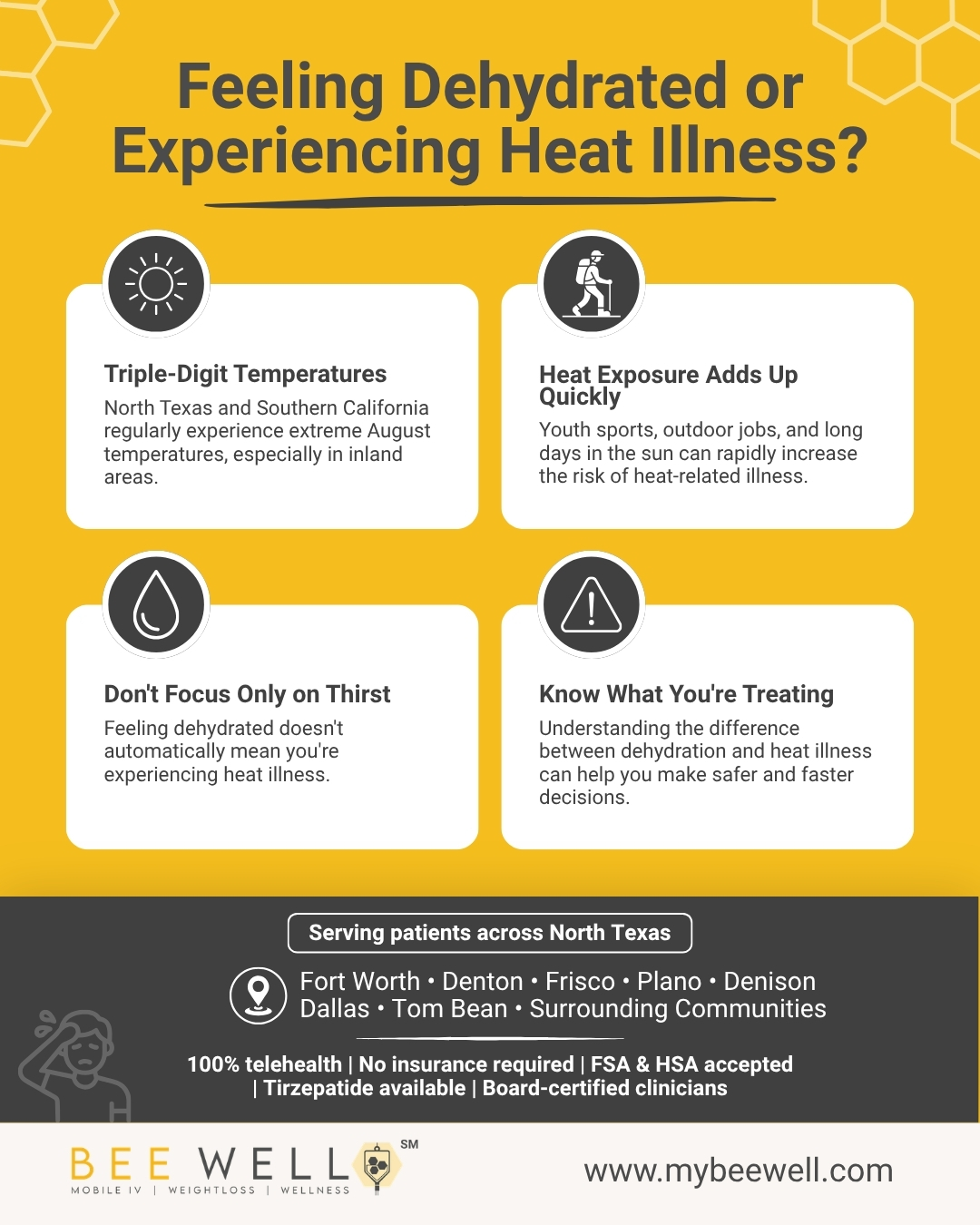
Through August, DFW afternoons sit in triple digits with heat indices well above the air temperature, and the same pattern runs through Frisco, Denton, Rockwall, Waxahachie, and Fort Worth. Southern California’s inland valleys behave the same way, with Simi Valley, Thousand Oaks and the Ventura County interior running far hotter than the coast strip at Malibu on the same afternoon. People finish a youth sports tournament or a day on a job site, feel wrung out, and start searching.
The distinction that matters in heat is not how dehydrated you feel. It is which heat illness you are looking at.
The National Weather Service describes heat exhaustion as heavy sweating, weakness, cool pale clammy skin, a fast weak pulse, cramps, dizziness, nausea, headache, or fainting, and the first aid is to move to a cool environment, loosen clothing, apply cool wet cloths, and “Offer sips of water.” Seek medical attention if vomiting occurs or symptoms last beyond an hour.
Heat stroke is a different emergency. The NWS lists throbbing headache, confusion, slurred speech, a body temperature above 103°F, hot red dry or damp skin, a rapid strong pulse, and loss of consciousness. Its instruction is unambiguous: “Call 911 or get the victim to a hospital immediately.” And then this, which almost no hydration article carries: “Do NOT give fluids.”
That single line is the reason we will not treat a heat emergency at your kitchen table. Someone confused and burning up in a parking lot in Waxahachie in August needs an ambulance, and a well-meaning attempt to hydrate them can make things worse.
Recognising the early signs before you reach that decision point is the more useful skill. Dr. Torres covers the symptom checklist, daily fluid targets, and when heat becomes an emergency in our complete guide to dehydration signs in the Texas heat.
Sorting Your Own Situation Before You Call Anyone
Most people can place themselves on this table in ten seconds.
| What you are experiencing | What the guidance points to | Where to go |
| Thirsty, dry mouth, urine darker than usual after a hot day | Drink fluid with salt and some sugar in it; keep drinking through the evening | Nowhere. Kitchen |
| Mild stomach bug, keeping sips down, no fever | Oral rehydration solution in small frequent amounts | Pharmacy shelf |
| Vomiting repeatedly, nothing staying down for hours | Oral route is failing; this needs assessment | Call your clinician or an urgent care |
| A known medical reason oral fluids will not work, identified by your doctor | Your doctor’s plan governs, including whether IV is appropriate and where | Your doctor |
| Confusion, fainting, no urination, racing heart, rapid breathing | Emergency symptoms per MedlinePlus | 911 or emergency room |
| Heat stroke symptoms: above 103°F, confused, hot dry skin | Do not give fluids; cool the person | 911 immediately |
Three of those six rows send you somewhere other than us. We would rather publish that than have someone book an appointment in the row where minutes count.
What We Turn Down, And Why We Would Rather Say It Here
A nurse arriving at your door is a clinical encounter, so it gets treated as one. Our nurses assess before anything is started, and there are visits we decline: emergency symptoms, anything that reads like heat stroke, and situations where the honest recommendation is a doctor rather than a drip. Turning down work is uncomfortable in an industry where the booking is the product, and it is still the right call.
What is left is narrower and more defensible than the category’s advertising suggests. A person who has been vomiting is past the point where sipping works, and needs fluid volume restored. Patients whose clinician has already told them oral fluids are not an option for a specific reason. Defined clinical circumstances, assessed at the door, with a licensed nurse deciding whether to proceed.
If that describes your situation and you want it handled at home rather than in a waiting room, that is what mobile IV therapy in Dallas exists for, and our Los Angeles and Ventura County Mobile IV Therapy service works the same way. The comparison between a home visit and a hospital setting covers what each one can and cannot do, and our intravenous therapy disclaimer sets out the limits in writing. Local coverage details for Frisco Mobile IV Therapy + Wellness Services and Denton sit on their own pages.
None of this is a substitute for care from your own clinician, and nothing here should be read as medical advice about your particular situation.
Deciding Whether An IV Is Worth It In Your Case
Ask three questions in order.
- Are any emergency symptoms present? Confusion, fainting, no urination, racing heart, or rapid breathing means 911 or an emergency room, immediately, with no appointment of any kind.
- Can you keep fluids down? If yes, drink something with salt and sugar in it, then reassess in an hour, because that is where the evidence sends you.
- Has a clinician who knows your history told you oral fluids will not work for you? Follow their plan.
Only after those three does an assessed home visit make sense. When it does, Bee Well sends a licensed nurse who evaluates you before anything begins and will tell you if the answer is a glass of water or an ambulance instead.