



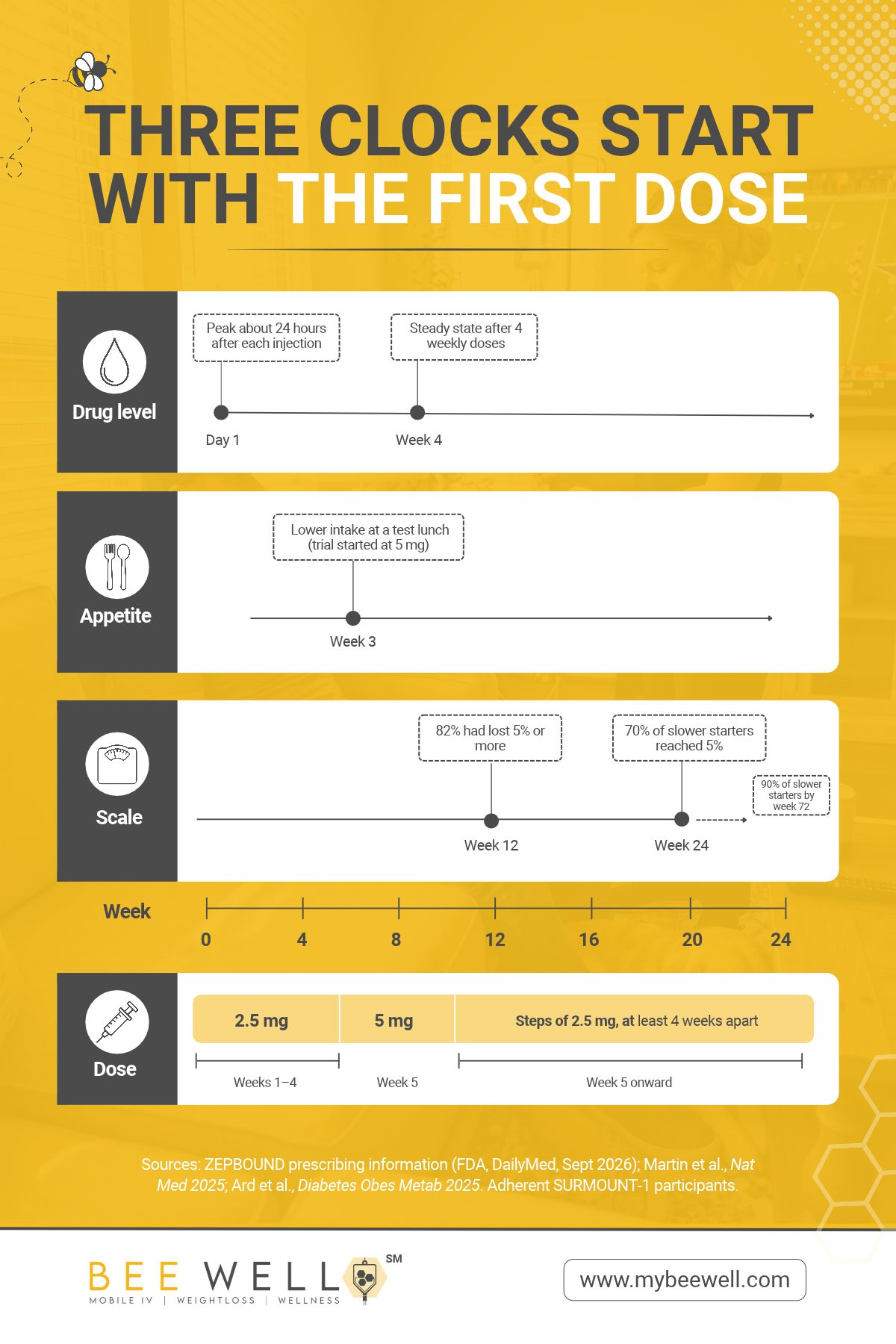
Tirzepatide takes about four weeks to reach steady levels in the blood at any given dose; appetite changes were measurable by week three in a controlled trial, and the scale runs on a slower and much less predictable clock. The honest answer to how long it takes for tirzepatide to work depends on which of those three clocks you are watching. In the SURMOUNT-1 trial data behind the FDA label, most adherent people had lost at least 5% of their weight by week 12, and most of those who had not got there later.
TL;DR
How long tirzepatide takes to work depends on what “working” means. The FDA prescribing information for the brand-name product says blood levels reach steady state after four weeks of once-weekly doses, and that the 2.5 mg starting dose is for initiation, not maintenance. A 2025 phase 1 trial measured lower food intake at week three.
For weight, a SURMOUNT-1 analysis of the FDA-labeled doses of adherent participants found 82% had lost 5% or more by week 12. The other 18% were slower starters, and 90% of them reached 5% by week 72, though their average total loss was about half that of the early group. None of this predicts one person’s result. It describes why the first month is built to be quiet.
What Does “Working” Mean for Tirzepatide?
Tirzepatide is working in the pharmacological sense within a day of the first injection, and it keeps building for about a month at each dose. According to the ZEPBOUND prescribing information on DailyMed, the median time to peak concentration after an injection is 24 hours, the half-life is about 5 days, and steady-state levels were reached after 4 weeks of weekly dosing.
That is one clock. The one people actually notice is appetite, and the one they are usually asking about is the scale. These three run at different speeds, which is why two people on the same schedule can describe the same fourth week completely differently.
| Clock | What the source reports | When | Source |
|---|---|---|---|
| Drug level | Peak concentration after each injection | Median 24 hours, range 8 to 72 | FDA label, section 12.3 |
| Drug level | Steady-state concentration at a dose | After 4 weekly doses | FDA label, section 12.3 |
| Stomach | Delay in gastric emptying | Largest after the first dose, then diminishes | FDA label, section 12.2 |
| Appetite | Lower intake at a test lunch versus placebo | Week 3, at 5 mg | Martin et al., Nature Medicine 2025 |
| Scale | 5% or more of body weight lost | Week 12 for 82% of adherent participants | Ard et al., Diabetes Obes Metab 2025 |
The label also describes the mechanism in plain terms: tirzepatide decreases calorie intake, and the effect is likely mediated through appetite. Weight follows eating, and eating follows appetite, so the scale is always the last of the three to move.
The appetite clock, measured
The clearest early measurement we found comes from a randomized phase 1 trial run at Pennington Biomedical Research Center and published in Nature Medicine by Martin and colleagues. Participants without diabetes ate an all-you-want lunch in the lab, and at week three the tirzepatide group ate an estimated 524.6 kcal less than the placebo group.
The same trial found lower self-reported hunger, fewer food cravings, and less tendency to overeat. One detail matters for anyone comparing notes: that trial started at 5 mg for three weeks, not at the 2.5 mg starting dose in the label. So the week-three finding describes a higher dose than most people take in their first month.
Why the First Month Is Built to Be Quiet
The first four weeks are designed around tolerance, not weight. The prescribing information states that the 2.5 mg starting dosage is for treatment initiation and is not approved as a maintenance dosage. The escalation exists to reduce the risk of gastrointestinal adverse reactions, and the label adds that most nausea, vomiting, and diarrhea events occurred during dose escalation and decreased over time. Put simply, the label expects you to spend a month at a dose it does not consider a treatment dose. A slow first month on 2.5 mg is the schedule doing what it was written to do.
After four weeks, the label moves to 5 mg. From there, steps of 2.5 mg are allowed after at least four weeks on the current dose, and the maintenance options are 5, 10 or 15 mg once weekly. Your prescriber decides whether and when to step up, based on your response and how you tolerate each dose.
| Weekly doses | Dose on the label schedule | What the label says about it |
|---|---|---|
| 1 to 4 | 2.5 mg | Initiation only, not a maintenance dosage |
| 5 to 8 | 5 mg | Lowest maintenance option |
| 9 onward | 7.5 mg, if stepped up | Increases of 2.5 mg after at least 4 weeks |
| 13 onward | 10 mg, if stepped up | A maintenance option |
| 21 onward | 15 mg, if stepped up | Maximum dose, earliest point on this schedule |
Those rows show the earliest each dose can arrive under the FDA-approved schedule. Many people step up later or stay at a lower dose, and none of that implies anything is going wrong.
Counting weeks by doses, not by the calendar
A missed dose shifts every row of that table. The label says a missed dose can be taken within 4 days (96 hours), and after that it should be skipped and the next dose taken on the regular day. Two skipped weeks in month one means the “week five” step is really a week seven step, and that matters when you are measuring progress against a schedule.
This is also where the brand label stops applying cleanly. If your tirzepatide comes from a compounding pharmacy rather than as a brand-name pen or vial, the dose forms and handling instructions come from that pharmacy and from your prescriber. The trial timing below was measured on the FDA-approved product at the labeled doses.
How Much Weight Is Lost by Week 12?
In the trial behind the label, most people had crossed 5% of their starting weight by week 12, and a sizeable minority had not. A post hoc analysis of SURMOUNT-1 by Ard and colleagues in Diabetes, Obesity and Metabolism looked at 1,545 tirzepatide-treated participants who received at least 75% of their assigned doses. Of those, 82% had lost 5% or more at week 12, and 18% had not. The authors called the second group late responders. That label is kinder and more accurate than “non-responders”, because of what happened next.
| Late responders (under 5% at week 12) | Result |
|---|---|
| Reached 5% or more by week 24 | 70% (194 of 278) |
| Reached 5% or more by week 72 | 90% (250 of 278) |
| Mean time to reach 5% | 24.8 weeks, give or take 12.7 |
| Mean weight reduction at week 72 | 11.0% |
| Early responders’ mean at week 72, for comparison | 22.5% |
Two things are true at once in that table. Most slow starters did reach a clinically meaningful loss, and slow starters as a group lost about half as much by week 72 as the fast starters did. An honest reading keeps both halves.
Neither half of that table is a forecast for any one person, including you.
Who the slower starters were
At baseline, the late responders were more likely to be male (45% versus 30%) and started heavier, at a mean of 110.2 kg against 103.6 kg. The authors suggest that a heavier body receiving the same fixed dose gets relatively less exposure to the drug, and they also point to insulin resistance as a possible factor. They present these as possible reasons, not findings.
Higher doses went with larger losses in both groups, according to the same analysis. Among late responders, the week-72 averages were 8.3%, 11.4% and 13.6% at 5, 10 and 15 mg.
The fine print on this data
In the same trial, every participant was counseled toward a daily deficit of 500 calories and at least 150 minutes of physical activity a week, so the drug was never measured alone. The analysis only included people who took at least 75% of their doses, which the authors name as a limitation because real-world adherence is often lower. The trial was sponsored by the drug’s maker, Eli Lilly and Company.
One author on the paper is at UT Southwestern Medical Center in Dallas. That does not change the numbers, but it is a reminder that a fair amount of the research behind these medications is being done a short drive from our patients in Frisco and Fort Worth.
Is Something Wrong If Nothing Has Changed by Week 4?
Not necessarily, and the label itself explains why. By the end of week four, you have taken only the initiation dose, which the FDA labeling says is not a maintenance dose, and levels at that dose have only just reached steady state. A flat scale at that point is consistent with how the schedule is designed.
Week four is a checkpoint for your prescriber, not a verdict on the medication.
What week four can tell you is how the medication is sitting with you. That is useful information for your prescriber, even when the weight has not moved at all.
The notes below are worth bringing to a check-in. They are questions and observations, not instructions:
- How many doses you have actually taken, counting any missed or skipped weeks
- Which dose you are on now, and how many weeks you have been on it
- Whether hunger, portion size, or cravings have changed, even if the scale has not
- Any nausea, vomiting, diarrhea, or constipation, and whether it is easing
- How and where the medication has been stored since it arrived
- Whether other medications, including any for blood sugar, have changed
Several of those points are for your prescriber to weigh, not for you to act on. Dose changes in particular are a clinical decision made with your history in front of them.
A North Texas Wrinkle Nobody Mentions: Heat on the Doorstep
When people across Dallas-Fort Worth ask why their first weeks felt different from a friend’s, storage rarely comes up. It should at least be ruled out, because the storage limits in the tirzepatide label sit below a normal North Texas summer afternoon.
The FDA prescribing information says single-dose pens and vials belong in a refrigerator at 36°F to 46°F. If needed, each one can be kept unrefrigerated at temperatures not exceeding 86°F for a total of up to 21 days, and then it is discarded. The multi-dose vial and the KwikPen carry a 30-day room-temperature limit at up to 86°F, and an opened KwikPen is thrown away after 30 days or 4 weekly doses, whichever comes first.
Now compare that 86°F ceiling with the weather. The NOAA NCEI 1991 to 2020 climate normals for DFW Airport put the normal daily high above it for four months of the year.
| Month | Normal daily high at DFW Airport | Above the label’s 86°F limit? |
|---|---|---|
| May | 83.6°F | No, but close |
| June | 91.5°F | Yes |
| July | 95.6°F | Yes |
| August | 95.8°F | Yes |
| September | 88.6°F | Yes |
| October | 78.4°F | No |
Four of those six months clear the label’s line, and one more comes close.
Those are normal highs in the shade at an airport weather station. A delivery box sitting on a Denton porch, or a pen left in a parked car in Fort Worth, can sit well past the air temperature. The label sets the limits; it does not describe what happens to a pen that exceeds them, and we will not guess.
Our weight loss medication is delivered to your door, so this is a practical question for our own patients from June through September, including those in Southern Oklahoma. If a package has sat out in the heat, the right call is to the pharmacy that dispensed it before the dose is used. Compounded tirzepatide carries its own pharmacy label and storage instructions, and those govern rather than the brand label quoted here.
Where Plateaus Fit, and Where This Page Stops
This page covers the start. The middle months have their own questions, and we have answered them separately.
If the scale moved well for several months and then stalled, that is a different situation from a slow start, and we cover it in our piece on why tirzepatide seems to stop working after a while. For a broader view that runs month by month across a first year on either GLP-1 medication, see what a GLP-1 program in Texas looks like across twelve months.
People are sometimes thrown by reading timelines for a different brand name on the same molecule. The trial timing above applies to tirzepatide under both of its brand names, which we explain in how Mounjaro and Zepbound relate to tirzepatide.
How We Pace the First Months With You
The start of treatment is where supervision earns its keep, because the numbers are at their least informative. Our program begins with a 15-minute telehealth consultation, and after that, check-ins run weekly to monthly depending on the phase you are in. Questions, side effects, and dose adjustments go through phone, text, or telehealth rather than a waiting room.
We keep the program the same wherever you are, but the local pages describe how it runs in each place. Patients in Collin County can read how the Frisco medical weight loss program works; Tarrant County patients have the Fort Worth version of the program, and there is a page for GLP-1 care in Denton as well.
If you are still deciding whether a supervised plan fits you, our medical weight loss program page sets out how the consultation, prescription, and delivery steps work. What we cannot tell you in advance is which of the two groups in that SURMOUNT-1 table you will fall into. Nobody can, and a provider who promises otherwise is guessing.
Bring Your Tirzepatide Week Count to the Next Check-In
Before you judge how tirzepatide is doing, count doses rather than calendar weeks, note which dose you are on, and write down what has changed with hunger as well as with weight. That short list turns “it isn’t working” into something a prescriber can actually assess.
If you are in Frisco, Fort Worth, Denton, or elsewhere in our service footprint and want that conversation with a provider who will read the numbers with you, Bee Well can set up a telehealth consultation. We will not promise you a number on a scale. We will make sure the schedule, the storage, and the questions are covered before anyone decides the medication has failed.