A study published June 16, 2026, in Annals of Oncology followed more than 229,000 people with obesity who did not have diabetes. Those taking a GLP-1 medication with semaglutide or tirzepatide had a 41% lower overall risk of developing an obesity-related cancer, with a 58% lower risk of endometrial cancer specifically. Earlier research in people with diabetes, plus laboratory studies in mice, point in the same direction. The science is genuinely promising, but it is observational; the follow-up is still short, and no doctor should prescribe tirzepatide for cancer prevention alone yet. What we can say with confidence: losing weight under medical supervision lowers your risk for at least 13 cancers, and tirzepatide remains one of the most effective tools available for that. If you are in Fort Worth, Denton, Frisco, Plano, Denison, or the surrounding North Texas area, Bee Well℠ can start you on a physician-guided plan from home.
What is tirzepatide?
Tirzepatide is the active ingredient in Mounjaro and Zepbound. It belongs to a class of medications called incretin therapies, and it works on two gut hormone receptors at once: GLP-1 (glucagon-like peptide-1) and GIP (glucose-dependent insulinotropic polypeptide). That dual action is what separates it from semaglutide (Ozempic, Wegovy), which targets GLP-1 alone.
In plain terms, tirzepatide slows how fast your stomach empties, quiets appetite signals in the brain, and improves how your body handles insulin and blood sugar. In head-to-head trials, it has produced some of the largest average weight reductions of any approved medication. For people carrying excess weight, that matters far more than the number on the scale, and the latest cancer research is a big reason why.
The 2026 study that put GLP-1s and cancer in the headlines
The most important new evidence came out this month. On June 16, 2026, researchers led by Dr. Aparna Kamat, director of the Division of Gynecologic Oncology at Houston Methodist Hospital, published a study in Annals of Oncology analyzing a national database of more than 229,000 people who had obesity but did not have type 2 diabetes.
That detail is what makes the study unusual. Most prior GLP-1 and cancer research looked at patients with diabetes. But as Kamat pointed out, the largest group taking these drugs today is younger, does not have diabetes, and has been “invisible in the literature.” Between December 2014 and June 2025, 38% of the people in the study received a GLP-1 prescription, while the other 62% received standard diet and exercise counseling.
The headline result: people taking semaglutide or tirzepatide had a 41% lower overall risk of developing an obesity-related cancer. Reductions of 50% or more showed up for endometrial cancer, multiple myeloma, pancreatic cancer, and colorectal cancer, with endometrial cancer dropping the most at 58%.
“A 41% reduction across more than 229,000 patients is not a small signal,” Kamat said. “That is the kind of number that, in any other context, would already be driving clinical guidelines.” She was careful to add that the study cannot prove the drugs themselves prevent cancer, only that a strong association exists.
The endometrial cancer finding stands out to me as the one worth watching. It is rising fastest in younger women, it is tightly linked to obesity, and as Kamat noted, medicine has had almost nothing to offer for prevention. A 58% drop, if it holds up in future trials, would be a meaningful change for a disease that has been heading in the wrong direction for years.
What earlier research found
The 2026 study did not appear out of nowhere. It fits a pattern that has been building for two years.
At the 2025 American Society of Clinical Oncology (ASCO) Annual Meeting, researchers presented data on 170,030 adults who had both diabetes and obesity, drawn from 43 health systems nationwide. Compared with patients taking an older diabetes drug class (DPP-4 inhibitors), those on GLP-1 medications showed a 7% lower risk of obesity-related cancers and an 8% reduction in all-cause mortality. The effect was stronger in women, who saw an 8% lower cancer risk and a 20% lower risk of death from any cause.
Laboratory work backs this up, too. At the Endocrine Society’s ENDO 2025 meeting, researchers reported that tirzepatide reduced body weight and body fat by roughly 20% in obese mice and slowed the growth of obesity-associated breast tumors. Interestingly, the protective effect seemed to come from changes to the animals’ overall metabolism and immune function, including restored CD8+ T cell activity, rather than the drug attacking tumor cells directly.
Why might tirzepatide lower cancer risk?
Researchers are still untangling this, and it is probably more than one thing working together.
The most established explanation is the weight loss program itself. Excess body fat drives chronic inflammation, hormonal imbalances, and insulin resistance, all of which create conditions where cancer can develop and grow. Take away a meaningful amount of that fat, and you take away some of that risk. Dr. David Greenberg, a hematology and oncology section chief in New Jersey, put it simply: anything that lowers inflammation in the body likely lowers cancer risk along with it.
The more intriguing possibility is that the drug does something beyond shrinking the patient. GLP-1 receptors are expressed directly on certain cancer cells, which raises the question of whether tirzepatide acts on tumors themselves. As Kamat said, “weight loss is likely an important contributor,” but separating the weight-loss effect from a possible direct drug effect is one of the biggest open questions in the field right now.
The honest caveats your doctor would mention
This is where careful marketing and good medicine agree: the research is encouraging, not conclusive.
The 2026 study was observational. It tracked what happened to people who happened to take these drugs versus those who did not, so it cannot rule out other explanations. People who get GLP-1 prescriptions may differ in income, activity level, diet quality, and how often they see a doctor. Dr. Lauren Carcas of the Miami Cancer Institute flagged exactly these confounders and noted another limitation: the median follow-up was only about two years, while many obesity-related cancers take far longer to develop.
There is also a more cautious thread in the literature. Some analyses of tirzepatide have raised questions about gynecologic tumor risk, which is part of why personalized medical evaluation matters so much. The evidence here is mixed and still developing, and it underscores the same point from every angle: these are prescription medications that belong under the care of a licensed clinician who knows your history.
So no, you should not start tirzepatide to prevent cancer. As surgical oncologist Dr. Anton Bilchik put it, more long-term research is needed before doctors can confidently prescribe these drugs for cancer risk reduction in people without diabetes. What you can do is treat obesity seriously, with medical guidance, and let the cancer-risk benefits be a meaningful bonus on top of everything else weight loss does for your health.
Thinking about medical weight loss in North Texas?
Bee Well℠ offers physician-guided tirzepatide and other weight loss treatments through a quick telehealth consultation, with medication shipped to your door. Book your consultation or call (817) 382-1277. We serve Fort Worth, Denton, Frisco, Plano, Denison, and surrounding communities.
Which cancers are linked to obesity?
The CDC links 13 cancers to excess body weight: breast (in women past menopause), colorectal, endometrial, esophageal, gallbladder, kidney, liver, meningioma (a type of brain tumor), multiple myeloma, ovarian, pancreatic, stomach, and thyroid.
That list is the real reason this research matters. Obesity is one of the few major cancer risk factors a person can actually change, and roughly 4 in 10 cancers diagnosed in U.S. adults are tied to factors within our control. A treatment that helps people lose significant weight and keep it off is doing cancer-prevention work, whether or not the drug has any direct effect on tumors at all.
How Bee Well℠ approaches medical weight loss
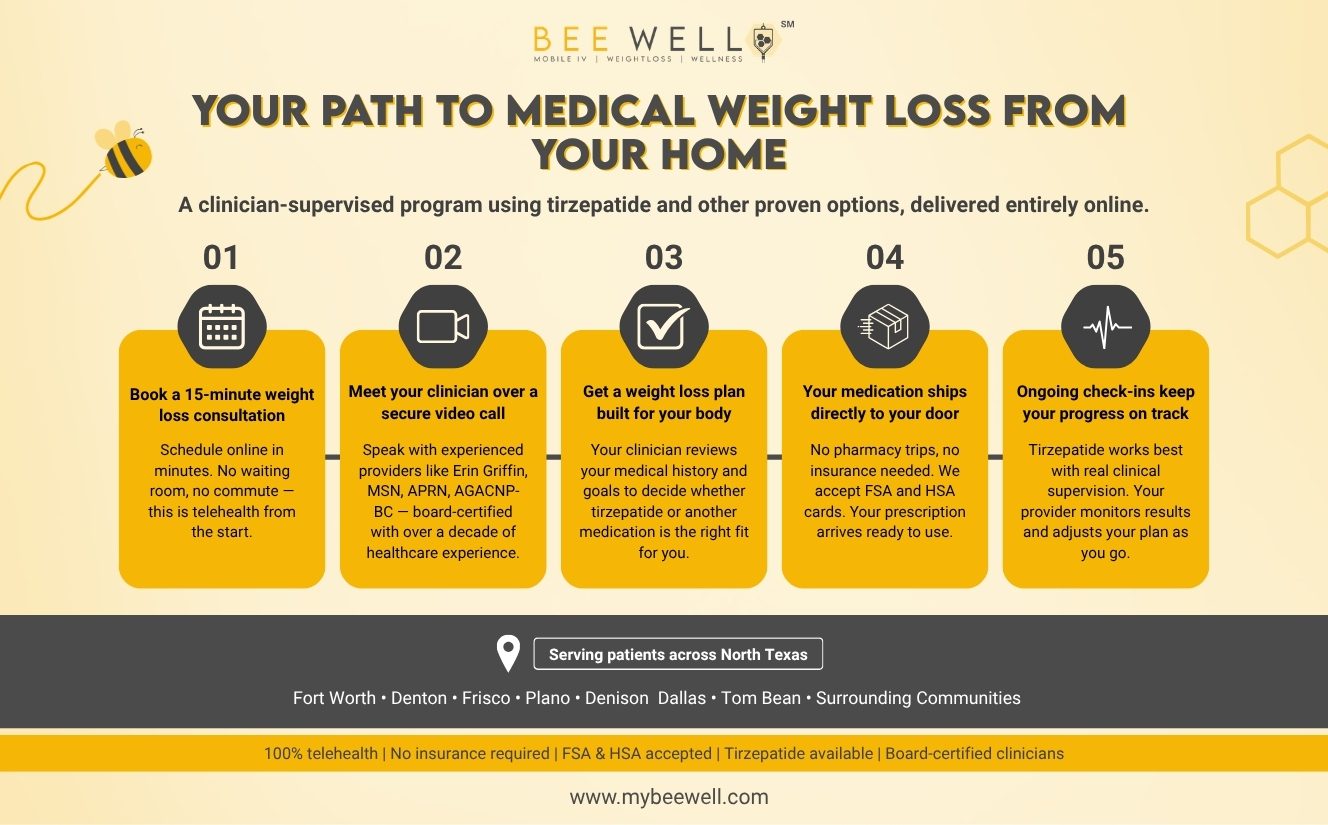
Bee Well℠ runs a fully telehealth-based weight loss program, so you never have to sit in a waiting room. You schedule a 15-minute consultation, meet with a licensed provider over a secure video call, and if tirzepatide or another option is appropriate for you, your prescription ships straight to your door. No insurance is required, and we accept FSA and HSA cards.
Our consultations are handled by experienced clinicians like Erin Griffin, MSN, APRN, AGACNP-BC, a board-certified nurse practitioner with more than a decade of healthcare experience. Every plan is built around your medical history, your goals, and ongoing check-ins, which is exactly the kind of supervision the research above calls for. Tirzepatide is a powerful medication, and it works best when a real clinician is monitoring your progress and adjusting along the way.
We proudly serve patients across North Texas, including Fort Worth, Denton, Frisco, Plano, Denison, Dallas, Tom Bean, and the surrounding communities.
Ready to start?
A licensed Bee Well℠ provider can review your goals and tell you whether tirzepatide is a fit, often with same-week availability. Schedule your telehealth consultation today or call (817) 382-1277.
This article is for general educational purposes and is not medical advice. Tirzepatide is a prescription medication that should only be used under the care of a licensed healthcare provider. Always consult a qualified clinician about your individual health, medications, and cancer screening.