



When you start a supervised weight loss program, the early weeks center on getting to know you, not handing you a one-size-fits-all plan. You can expect an intake conversation about your health history, current habits, and goals, often paired with basic lab work and a review of any medications you take. A clinician then talks through options that fit your situation, which may include lifestyle coaching, nutrition support, and, for some people, a medication discussion. The first month is mostly about building a baseline, seeing how your body responds, and setting up regular check-ins. Nothing should feel rushed or generic. Good programs avoid promises about exact numbers because results genuinely differ from person to person. If you walk in with questions and leave with a plan that feels made for you, that is the experience you want.
What Actually Happens in Your First Few Weeks?
The first few weeks of a supervised weight loss program are built around assessment and setup, not dramatic change. Most people imagine starting a treatment on day one, but that is rarely how care works. Instead, the early stretch helps your care team understand your starting point so the plan that follows actually fits you.
Here is the part that surprises a lot of people: the slow, methodical opening is the feature, not a delay. A team that takes time up front is far more likely to catch something that matters, like a thyroid issue or a medication interaction, before it becomes a problem. So if your first visit feels more like a long conversation than a transaction, that is a good sign.
Across the Fort Worth and DFW area, people come in with very different histories. Some have tried several diets. Some have never worked with a clinician on weight before. Some are curious about newer options they have read about online. The program meets each of those starting points differently, which is exactly the point.
It helps to picture the rhythm of those early weeks. Week one is usually the intake and any lab orders. Week two often brings the lab results back and a follow-up conversation about what they show. By weeks three and four, you and your clinician are settling into a plan and a check-in schedule. None of this is rigid, and your program may move faster or slower depending on what your history calls for. The point is that the opening month is a deliberate sequence, not a single appointment where everything is decided at once.
How a Supervised Weight Loss Program Typically Begins
A supervised weight loss program usually begins with an intake visit that gathers your medical background, current routine, and what you hope to change. This is the foundation everything else rests on. Expect questions about sleep, stress, past attempts at weight management, family history, and any conditions or medications already in the picture.
Many programs include baseline lab work at or near this first visit. Bloodwork gives the clinician objective information about things like blood sugar, cholesterol, and organ function. None of this is about judging you. It is about building an accurate picture so the recommendations that follow are grounded in your actual health, not guesswork.
After the intake and any labs, your clinician walks through options. For some people, that means a focus on nutrition and movement coaching. For others, the conversation may include medication that supports appetite regulation. People often arrive having read about specific names, and that is normal. Curiosity about how different approaches compare, like questions around retatrutide vs ozempic or reta vs ozempic, comes up a lot. A good clinician answers honestly, explains how options work in general terms, and helps you understand what suits your case rather than steering you toward a trend.
By the end of the opening phase, you should have a plan, a schedule of follow-ups, and a clear sense of who to contact between visits. That structure is what separates a real program from simply getting a prescription and being sent on your way.
It is worth naming what a strong start does not look like, too. You should not feel rushed through a five-minute visit. You should not be handed a medication with no explanation of how it works or what to watch for. You should not leave without knowing when your next contact is or how to reach someone with a question. If any of those things happen, it is fair to ask for more, or to look for a program that treats the opening month as the careful work it should be.
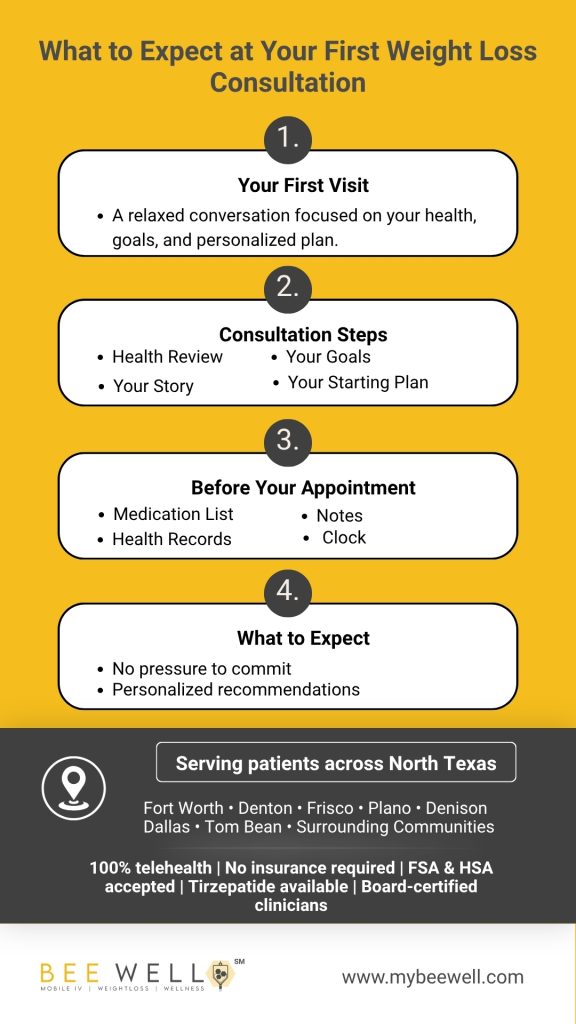
What a first consultation usually covers
A wellness consultation at the start of a program tends to touch on a few consistent areas:
- Your full health history and current medications
- Goals in your own words, not a number a chart assigns you
- Daily habits around food, movement, sleep, and stress
- Any past weight management efforts and how they went
- Lab results and what they mean for your options
- A plan for follow-up and ongoing support
This is also your chance to raise anything that has worried you. If you have read that a treatment can cause side effects, ask. Honest questions early make the whole process smoother.
One more thing this first conversation does: it sets the tone for how you and your care team work together. A consultation that feels collaborative, where the clinician asks what matters to you and listens to the answer, tends to predict a program that stays collaborative. You are starting a relationship, not buying a product off a shelf, and the opening visit is where that relationship takes shape.
Why Does Clinician Guidance Matter So Much?
Clinician guidance matters because weight is connected to nearly every system in your body, and managing it safely takes someone who can see the whole picture. A trained clinician monitors how you respond over time, adjusts the plan, and watches for issues that a self-directed approach would miss.
One real example is the way some people find that a medication seems to work differently over time. Plenty of people search things like “tirzepatide stopped working” or “does tirzepatide stop working after a while,” and it is a fair concern. Bodies change, life circumstances shift, and what felt effective at first can change. A clinician can help interpret what is actually happening and talk through next steps, rather than leaving you guessing. We cover this topic in more depth in our guide on when tirzepatide stops working.
Guidance also matters for the practical stuff. Questions about technique, like figuring out where to inject semaglutide, are common and completely reasonable. So are questions about how certain treatments interact with daily life, such as tirzepatide and alcohol. Having a person to ask removes the anxiety of trying to piece answers together from random sources.
Side effects are another reason a clinician in your corner helps. Some people notice changes in sleep or headaches when starting certain medications, and there is solid information on whether semaglutide can cause insomnia. and on whether semaglutide can cause headaches. The benefit of supervision is that you are not interpreting these signals alone.
There is a safety layer here that is easy to overlook. A clinician keeps track of how a medication fits with the rest of your health, including conditions you may not connect to weight at all. They can flag when a dose should be adjusted, when a symptom is worth a closer look, and when something you are feeling is expected versus when it deserves attention. That ongoing watchfulness is hard to replicate on your own, and it is one of the clearest reasons supervised care beats going it alone.
Lifestyle Support Alongside Any Treatment
Lifestyle support is a part of a program that does the long-term work, and it runs alongside any treatment rather than competing with it. Medication, when it is part of the plan, is a tool. The habits you build around food, movement, sleep, and stress are what make progress last.
Good programs treat nutrition as personal. There is no single diet handed to everyone. Instead, support tends to focus on realistic changes that fit your schedule, your budget, and the food you actually like. Small, repeatable adjustments beat dramatic overhauls that fall apart by week three. A clinician might suggest adding protein to breakfast, swapping one daily drink, or planning two simple dinners you can repeat, rather than asking you to overhaul your whole kitchen at once.
Movement support works the same way. The goal is not punishing workouts. It is finding an activity you will keep doing, whether that is walking the Trinity Trails, joining a class, or just adding short bursts of movement to a busy DFW workday. Consistency matters more than intensity in the early going. Ten minutes you actually do beats an hour you dread and skip.
Hydration and recovery often get folded in too. Some clients pair their program with services like IV hydration to support energy and wellness, and many people in the area look into IV therapy in DFW as a complement. These add-ons are optional and individual, never a substitute for the core plan, but they show how a well-rounded program thinks about your overall wellness rather than a single number.
Sleep and stress round it out. Both have a real effect on appetite and energy, and a program that ignores them is missing a big lever. Poor sleep alone can push hunger hormones in the wrong direction and make a hard week harder. Expect your team to ask about these areas and to offer practical strategies, not lectures.
What Questions Should You Ask at Your Consult?
The best questions at your consult are the ones that help you understand your specific plan, the support behind it, and what happens if something changes. Walking in prepared turns a consultation into a real conversation instead of a sales pitch.
Here are questions worth bringing:
- What does my health history mean for my options?
- What does the first month look like for someone like me?
- How often will we check in, and who do I contact between visits?
- If a treatment is recommended, how does it work, and what are the common side effects?
- How will we know if the plan is working, and what do we do if it is not?
- What lifestyle support is included, and how is it personalized?
- Are there options I have read about, like newer peptides, that you would or would not recommend for me, and why?
That last point matters. People often come in curious about specific compounds they have seen discussed online, including questions about be well peptides or interest in retatrutide for weight loss. A good clinician explains general mechanisms, sets honest expectations, and tells you plainly whether something fits your situation. You should never feel pressured toward a particular product.
It is also fair to ask about the practical side of the program. How much will it cost, and what is included in that price? What happens if you need to pause or stop? Is there support between scheduled visits, and how quickly can you expect a response? These logistics shape your experience as much as the clinical plan does, and a transparent program will answer them without hesitation.
Setting clear weight loss expectations during this conversation protects you. You find out what is realistic, what is not, and how the team will support you either way.
Why Results Vary and Why Your Care Should Be Individual
Results vary because every person brings a different body, history, and set of circumstances, and that is exactly why your care should be built around you instead of a template. Anyone promising a specific number on a specific date is overselling. Honest programs talk in ranges and possibilities, not guarantees.
Several things influence how a person responds. Genetics, hormones, age, stress, sleep, existing conditions, and the medications you already take all play a role. Two people can follow the same plan and see different timelines, and neither is doing anything wrong. Understanding that up front saves you a lot of frustration. It also takes the pressure off comparing your week-four progress to someone else’s social media post, which is rarely a fair or accurate measure.
Individualized care also means the plan can change. The version that fits you in month one may need adjusting by month three as your body responds or your life shifts. That flexibility is a strength. It is the reason ongoing supervision beats a static prescription handed out once and forgotten.
This is also why comparison shopping between treatments based on internet buzz alone rarely serves people well. What works beautifully for a friend or a stranger online may not be the right starting point for you. The value of a clinician is translating all that general information into a plan that fits your one specific situation.
There is a longer view worth keeping in mind. Weight management is rarely a single sprint with a finish line. It tends to move in phases, with periods of steady change, periods that plateau, and moments where the plan needs a fresh look. A program built around you expects those phases and meets them, rather than treating any slowdown as failure. That patience, backed by someone tracking your progress with you, is what carries results past the first few months and into something you can hold onto.
Ready to Talk Through your Options?
If you are weighing whether a supervised approach is right for you, the simplest next step is a conversation. At Bee Well℠. We build plans around your history and goals, with clinician guidance and lifestyle support at every step. Reach out, ask your questions, and see what a first month built for you could look like.