



Most people on semaglutide or tirzepatide drink less than they used to without noticing. Appetite suppression blunts thirst along with hunger; food carries a surprising share of daily fluid, and nausea makes drinking unappealing. Add any vomiting or diarrhea and fluid loss outpaces intake quickly.
For most people, most of the time, deliberate sipping through the day and attention to electrolytes handle it. The part worth knowing is where that stops being enough. Ozempic’s FDA label carries a warning for acute kidney injury due to volume depletion, noting postmarketing reports of kidney injury “in some cases requiring hemodialysis,” with the majority occurring in patients who had gastrointestinal reactions leading to dehydration. Persistent vomiting or diarrhea, dark urine, passing very little urine, or dizziness on standing are provider calls, not fix-it-at-home situations.
Here’s What This Covers
There is a lot of hydration advice aimed at people on GLP-1 medications, and nearly all of it stops at “drink more water.” That advice is fine, and it is incomplete, because it never tells you what to do when drinking more water is not working.
What follows is why these medications reduce fluid intake through several routes at once rather than just one, why plain water alone can be the wrong answer in some situations, the specific warning the FDA added and what it actually says, a clear line between manage-at-home and call-someone, and an honest note about IV hydration from a clinic that provides it, including the situations where it is the wrong call.
Why GLP-1 Dehydration Happens So Quietly
The reason this sneaks up on people is that no single dramatic thing goes wrong. Several small changes stack.
Appetite suppression is not selective. The same signalling that quiets hunger tends to quiet thirst, so the internal prompt that used to send you to the tap several times a day simply fires less often. People describe not feeling thirsty rather than feeling parched, which is why they do not think of themselves as dehydrated.
Then there is food. Roughly a fifth of most people’s daily fluid comes from what they eat rather than what they drink, and on a GLP-1, you are eating substantially less. Cutting portions in half quietly cuts that contribution in half too, and nobody counts it.
Slower gastric emptying adds a third effect. Fluid sits in the stomach longer, so drinking a large glass produces a full, sloshing feeling that discourages the next one. People respond by drinking less, which is the opposite of what they need.
Finally, nausea. Even mild nausea makes the idea of drinking unappealing, and nausea is most common in the days after a dose increase, which is exactly when intake matters most.
None of these is alarming alone. Together they can move someone into genuine fluid deficit while they feel nothing more than a bit tired and headachy.
What The FDA Label Actually Says
This is the part most hydration articles skip, and it is the reason to take the topic seriously.
The prescribing information for Ozempic includes a section titled Acute Kidney Injury Due to Volume Depletion. Its wording is direct: “There have been postmarketing reports of acute kidney injury, in some cases requiring hemodialysis, in patients treated with semaglutide. The majority of the reported events occurred in patients who experienced gastrointestinal reactions leading to dehydration such as nausea, vomiting, or diarrhea.”
It also instructs prescribers to “monitor renal function in patients reporting adverse reactions to OZEMPIC that could lead to volume depletion, especially during dosage initiation and escalation,” and to tell patients to promptly report persistent nausea, vomiting, and diarrhea.
Two things follow from that. Dose increases are the higher-risk windows, not steady maintenance. And the mechanism is not the drug attacking the kidney directly; it is fluid loss reducing blood flow to the kidney. That is worth understanding because it means the problem is preventable and, caught early, reversible.
The same label notes that severe gastrointestinal reactions occurred more often on semaglutide than placebo in trials, and that the medication is not recommended for people with severe gastroparesis. If you have a pre-existing motility condition, this conversation belongs with your prescriber before you start.
Signs, Sorted By What You Should Do About Them
Not every symptom carries the same weight. This is roughly how to triage them.
| What you notice | What it usually means | What to do |
| Mild thirst, dry mouth, urine darker than usual | Early, common, easily corrected | Sip steadily through the day, add electrolytes |
| Headache, fatigue, light-headedness when standing quickly | Meaningful fluid deficit | Increase intake deliberately, add electrolytes, tell your provider at the next check-in |
| Muscle cramps, constipation that is worsening | Fluid and electrolyte imbalance | Same as above, and review whether your dose schedule is moving too fast |
| Vomiting or diarrhea lasting more than a day | Losses outpacing anything you can drink | Contact your provider; do not wait it out |
| Very dark urine, passing little or no urine | Possible kidney involvement | Seek medical care promptly |
| Dizziness that does not resolve, confusion, fainting | Serious volume depletion | Urgent medical care |
The middle of that table is where people get stuck. They know they feel off, they assume it is just the medication working, and they wait. Persistent vomiting and diarrhea are the specific things the FDA label tells patients to report promptly, so treat them as a call rather than a wait.
Why Water Alone Is Sometimes The Wrong Answer
Plain water is right for ordinary low-grade dehydration. It becomes insufficient when you are losing electrolytes as well as fluid, which is what happens with vomiting and diarrhea.
Replacing heavy losses with water only can dilute sodium further, which is why people occasionally feel worse after forcing large volumes of plain water. An oral rehydration solution, which contains sodium, potassium, and a small amount of glucose to drive absorption, is designed for exactly this and is available at any pharmacy.
Practical adjustments that tend to work better than “drink more”:
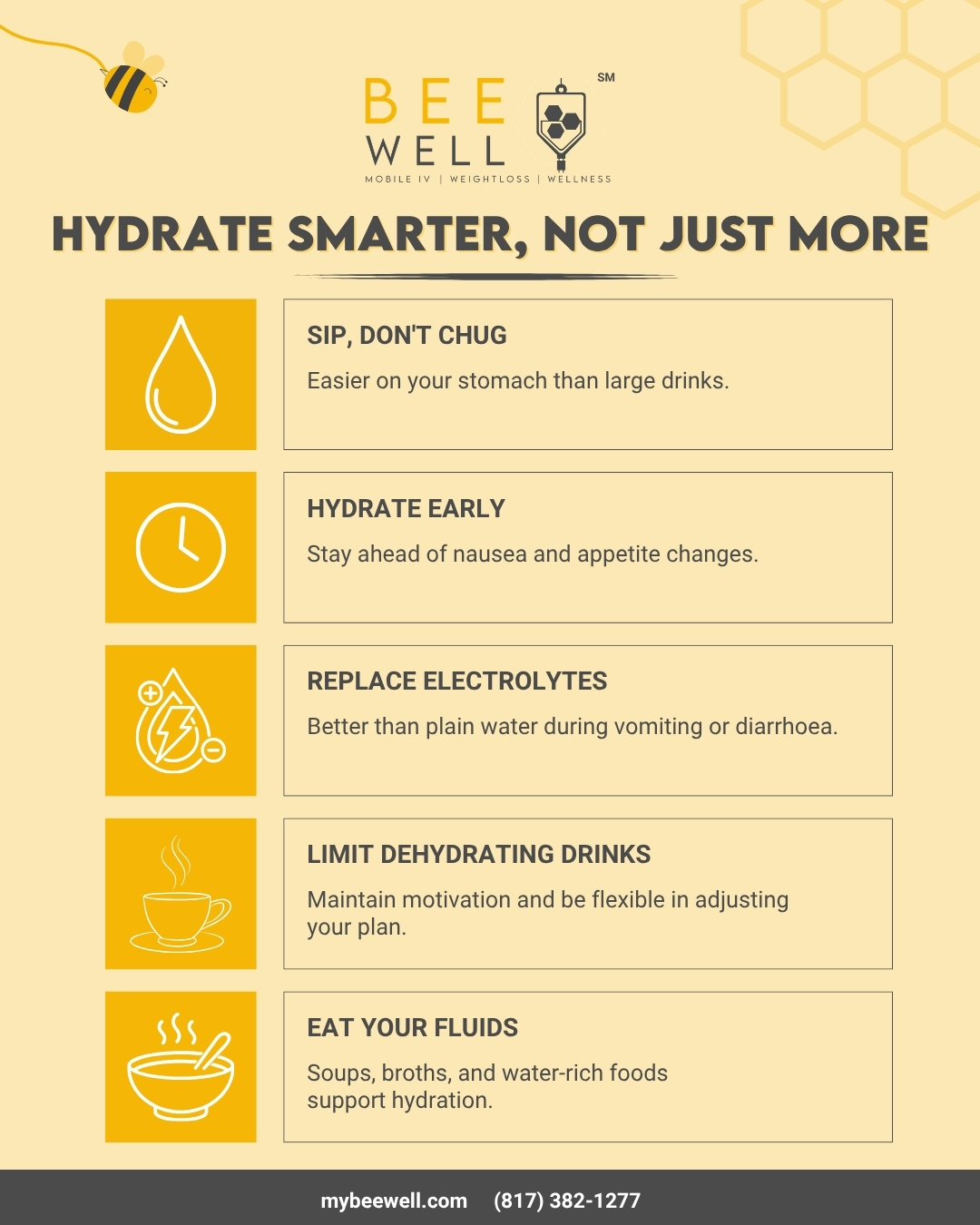
- Sip small amounts frequently rather than downing a large glass, which works with slowed gastric emptying rather than against it
- Front-load fluid earlier in the day, before appetite suppression and nausea peak
- Use an oral rehydration solution rather than plain water on days with vomiting or diarrhea
- Watch caffeine and alcohol during dose-increase weeks
- Include soups, broths, and high-water foods, since you have lost the fluid your old portion sizes used to supply
If you are on a diuretic or a blood pressure medication, do not adjust anything on your own. Fluid shifts interact with those, and that adjustment belongs to whoever prescribed them.
The Week After A Dose Increase Deserves A Plan
Since the label singles out initiation and escalation as the periods to watch, it makes sense to treat those weeks differently rather than hoping they go smoothly.
A workable approach is to decide in advance what the week looks like. Put fluid earlier in the day, before nausea typically peaks. Keep an oral rehydration solution in the cupboard before you need it, because the day you need it is not the day you want to be looking for a pharmacy. Plan lighter, softer meals with more liquid content for the two or three days after the injection. And set a rough personal threshold ahead of time, for example, that vomiting twice in a day or a full day of not being able to keep fluids down means you make a call rather than tough it out.
That last one matters more than it sounds. In the moment, people are reluctant to bother anyone, and they talk themselves into waiting one more day. Deciding the threshold while you feel fine removes that judgement call from the worst possible moment to be making it.
It is also worth tracking, loosely, how each escalation went. If every dose increase produces several days of real fluid trouble, that is information your provider can act on by slowing the schedule. Escalation speed is adjustable, and there is no prize for reaching a target dose on the manufacturer’s default timeline if the trip there keeps putting you in deficit.
An Honest Note On IV Hydration
We provide IV hydration, so treat this section as coming from an interested party and weigh it with that in mind.
IV fluids restore volume and electrolytes faster than drinking, and there are legitimate situations where someone who cannot keep fluids down benefits from that. What IV hydration is not is a treatment for the underlying problem, and it is not a way to manage GLP-1 side effects on an ongoing basis.
Here is the line we hold. If you are vomiting persistently, passing very little urine, or dizzy enough to be unsteady, the right destination is your prescriber or urgent care, not a wellness appointment. Those symptoms need someone checking kidney function and reviewing the medication, which is a clinical evaluation rather than a bag of fluid. Booking a drip in that situation can make you feel better temporarily while the thing that actually needs attention goes unexamined.
IV hydration is also not appropriate for everyone. People with kidney disease or heart failure can be harmed by a fluid load, so anyone with those conditions needs their own physician’s input first, not ours.
Where it does fit reasonably is the middle ground: a rough stretch after a dose increase where you are behind on fluids, keeping some liquid down, and not showing the warning signs in the lower half of that table. Even then, the more useful conversation is usually why the dose escalation is producing that much nausea in the first place, which is a question for the person managing your programme.
What Good Supervision Looks Like
The reason this matters for how you choose a provider is that GLP-1 dehydration is largely a titration problem. Move the dose up too fast and nausea, reduced intake, and fluid deficit follow predictably.
A well-run medical weight loss programme asks about fluid intake and gastrointestinal symptoms at every check-in rather than only tracking the scale, is willing to hold a dose or extend the interval when someone is struggling, which is what doctor supervised weight loss is actually for, knows to involve your prescriber about renal function when symptoms warrant it, and gives you a clear instruction for what to do at 9 pm on a Saturday when you have been vomiting since morning.
If your current arrangement is a monthly refill and no conversation, that is the gap. Most of the serious cases described in the label narrative are not mysterious; they are ordinary side effects that nobody was watching closely enough.
Quick recap
The short version is that GLP-1 dehydration builds from several small changes at once: thirst signalling drops, food-based fluid disappears with smaller portions, and nausea discourages drinking, so it arrives without ever feeling dramatic. Most of it is handled by sipping steadily, front-loading fluid earlier in the day, and reaching for an oral rehydration solution rather than plain water on bad days. The part to take seriously is the FDA’s warning about kidney injury from volume depletion, which means persistent vomiting, very dark or scant urine, or real dizziness are reasons to contact a clinician rather than to push more water. If you want a programme where someone is actually asking these questions between doses, Bee Well is happy to talk it through.
This article is general information, not medical advice. Do not start, stop, or change any medication based on it. Anything here that sounds like your situation is a conversation for your prescriber.