Key Takeaways
- Of eleven DFW practices we checked that offer or discuss exosome services, zero publish a price. Several publish the price of the base procedure and withhold the exosome number.
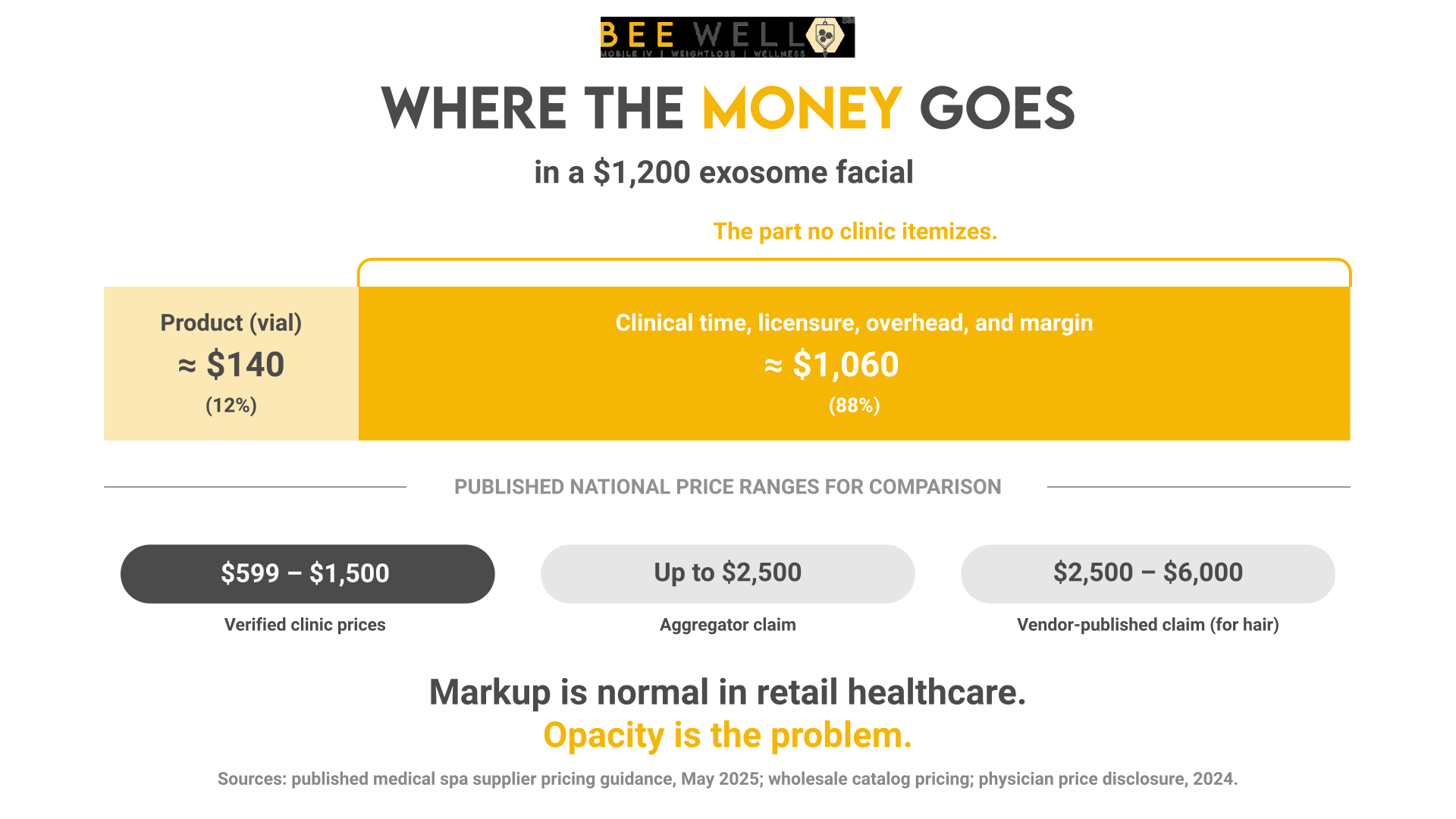
- A supplier’s own pricing guide tells medical spas to buy vials at roughly $140 and charge $300 to $1,500. That is a 2x to 6x markup, published by the industry to the industry.
- The particle counts clinics advertise are not comparable between providers. Two nanoparticle tracking instruments measuring the same sample can differ by more than twofold, and a NIST study found discrepancies across methods reaching two orders of magnitude.
- There is no CPT or HCPCS code for exosome therapy. It is not denied by insurers so much as absent from the coverage system entirely, which means there is nothing to appeal.
- HSA and FSA use for aesthetic exosome treatment is on shakier ground than most cost guides admit. IRS Publication 502 names hair transplants as a non-deductible cosmetic expense, and the IRS issued an enforcement alert in 2024 about exactly this framing.
- Medical credit cards commonly carry a 32.99 percent purchase APR with deferred-interest promotions. The CFPB found roughly one in five deferred-interest healthcare purchases ended up assessed interest, rising to one in three for consumers with credit scores below 619.
Why nobody will give you a number
Call three providers in the metroplex and ask what exosome therapy costs. You will get three different answers, none of them itemized, and at least one “we confirm pricing at consultation.”
We checked eleven DFW practices that offer or discuss exosome services, from Frisco medical spas to Dallas dermatology offices to regenerative clinics on North Central Expressway. Not one publishes an exosome price. One Dallas medical spa publishes microneedling at $450, $600, and $700 depending on treatment area, then states that “PRP, exosome and GHK-Cu pricing are confirmed at consultation.”
That single line explains the whole market. The base procedure is a commodity with a public price. The exosome add-on is where the discretionary margin sits, and it is deliberately opaque.
This article does not publish our prices either, because a number without an itemization is exactly the problem. What it does is give you the four variables behind every quote, the actual wholesale economics, and the questions that make two quotes comparable.
The four variables that set the price
1. Product volume and how it is counted
Exosome preparations are sold by volume and by particle count. A quote covering a single 1 mL vial applied topically and a quote covering a multi-vial protocol are not in the same universe.
Particle counts are where this gets genuinely strange. Suppliers quote in at least five units that do not convert to one another: trillions of microvesicles per vial, billions of particles per vial, billions of particles per milliliter, milligrams of secretome, and proprietary potency units. One supplier catalog lists a 1 mL product at one trillion microvesicles. A physician’s published price disclosure lists a product with the same name at 1.4 billion particles. That is a roughly 700-fold gap between two published sources for what appears to be the same item.
2. Sourcing, lab standards, and testing
This is where the largest legitimate cost difference hides. Products from labs that run donor screening, sterility testing, endotoxin testing, and validated cold chain cost meaningfully more than products that skip steps. Sterility validation failures have been cited by name in FDA warning letters to exosome manufacturers, so the cheaper input is not a neutral trade.
3. Delivery route and clinical time
A topical application after microneedling takes a fraction of the clinical time an intravenous protocol does. Route also determines who has to be in the room, what monitoring is required, and how long the appointment runs. A quote that does not specify the route is incomplete.
4. Session count in the protocol
A per-session price and a protocol price answer different questions. Some providers quote one session knowing the recommendation is three. Ask what the full course looks like and what the total comes to, then compare totals.
What the vials actually cost
Wholesale pricing in this category is published, if you know where to look, because suppliers sell to practices through catalogs that require a provider account rather than a password.
| Source | What it reports |
|---|---|
| Medical spa supplier pricing guide, May 2025 | Instructs practices to price an exosome add-on at $300 to $800 and a standalone exosome facial at $900 to $1,500, against a stated vial cost of roughly $140. States the resulting gross profit as $300 to $900 per treatment. |
| Wholesale catalog, MSC exosome line | 1.0 mL vial at $350 to the provider; 5.0 mL at $1,200; an enhanced 1.0 mL formulation at $800. |
| Wholesale catalog, placental secretome line | 1.0 mL vial at $175; 5.0 mL at $850. |
| Plant-derived exosome product, wholesale | $149 per unit, $145 at volume. |
| Physician’s own published disclosure, 2024 | Clinic pays $350 to $3,000 per vial depending on product; charges $600 to $800 for a $350 vial and $1,400 to $2,000 for an $800 vial. |
So the markup runs roughly two to six times the acquisition cost, and the industry publishes that guidance to itself openly. That is not automatically outrageous. Clinical time, licensure, insurance, and overhead all cost real money, and every retail healthcare service marks up its supplies. It is context you are entitled to have while you evaluate a $1,200 quote.
There is a more critical estimate worth including for balance. Paul Knoepfler, a stem cell biologist at UC Davis, has written that sellers “are often charging thousands of dollars for something that likely costs only about $50 to $100 per dose to make.” That is a manufacturing-cost estimate rather than measured acquisition data, and it sits below even the cheapest verified wholesale price, so treat it as an argument rather than a figure.
Why the particle count on your quote means less than you think
“Fifteen billion exosomes” sounds like a specification. It is closer to a marketing figure, and the measurement science says so out loud.
A 2017 study in the Journal of Extracellular Vesicles ran the same samples through two nanoparticle tracking instruments in different laboratories. Particle size measured reproducibly, with coefficients of variation around 2 to 3 percent. Concentration did not. Day-to-day concentration variation ran to 14 percent, and the study found significantly different results between the two instruments using identical software settings.
A 2019 comparison went further. One instrument overestimated the concentration of reference nanospheres by roughly twofold. Measured against serial dilutions of real vesicle samples, one device showed a bias range of 2.7 to 8.5 percent and the other 32.9 to 36.8 percent. The authors concluded that “NTA devices differ strongly in their hardware and software affecting measuring results.”
A 2025 NIST-affiliated study comparing four measurement methods found “quantitative discrepancies in particle number concentrations reached up to two orders of magnitude across methods and cell sources.” Up to one hundred fold.
MISEV2023, the field’s own consensus standard, is direct about the underlying problem. Particle concentration “is often unreliable, since many techniques lack specificity for EVs and sensitivity for all EVs,” and for methods that cannot distinguish vesicles from co-isolates, concentration “be reported as ‘particle or EP concentration’ and not ‘EV concentration.'”
That quote is from a supplier, not a critic. When the person selling the vials says the number on the box is not a valid measure, comparing “5 billion” at one clinic against “15 billion” at another is not a comparison at all.
WHAT TO DO WITH THIS AT A CONSULTATION
You can still ask for the particle count. Ask two follow-ups with it: which measurement method produced the number, and which laboratory ran it.
A provider who can answer both is paying attention. A provider who quotes the number off a product sheet without knowing either is repeating marketing copy, which tells you what you need to know about the rest of the quote.
Why a low quote can be a warning sign
In most consumer categories a lower price means a thinner margin. In this one it often means a different product.
The cost floor for a well-documented preparation is set by the lab work behind it. When a quote lands far below the local range, the usual explanations are less product than you assumed, a supplier with lighter testing, or a per-session number attached to a multi-session plan. Any of those is worth knowing before you pay, and a provider who cannot say which one applies has answered the question.
There is a mirror-image problem at the top end. The highest published “typical ranges” in this category come from pages with a commercial interest in anchoring readers high. One widely ranking cost guide, published by a company that sells exosome products, tells readers that “prices below roughly $1,500 should always raise questions,” while verified clinic menus for the same category of treatment run $599 to $1,500. Read a cost guide’s ownership before you read its numbers.
Insurance, HSA, and FSA: the part most cost guides get wrong
Insurance
Exosome services are not covered. The reason is more structural than a denial. There is no CPT or HCPCS code specific to exosome therapy in the 2026 code set, and we could not locate a single major payer medical policy that names exosome therapy at all. Payers have not rejected it so much as never built a place for it. There is nothing to appeal and no medical-necessity pathway to pursue.
HSA and FSA
Several top-ranking national cost guides tell readers flatly that they can use HSA or FSA funds for exosome therapy. For elective aesthetic or general wellness treatment, that guidance is wrong, and the IRS has said so in more than one place.
IRS Publication 502 defines qualifying medical expenses as costs of “diagnosis, cure, mitigation, treatment, or prevention of disease,” and requires that care be “primarily to alleviate or prevent a physical or mental disability or illness.” It excludes what is “merely beneficial to general health.” On cosmetic procedures it is more specific still, naming “face lifts, hair transplants, hair removal, and liposuction” as non-deductible, with a narrow exception for deformity from congenital abnormality, accident, trauma, or disfiguring disease.
An exosome scalp treatment for pattern hair loss sits close to a named example. An aesthetic exosome facial does too.
A physician’s recommendation does not by itself create eligibility. The IRS addressed this directly in a 2023 FAQ, answering that an expense does not qualify when it is “only for the improvement of general health,” even if a doctor recommended it. And in March 2024 the agency issued an alert warning consumers about “companies misrepresenting nutrition, wellness and general health expenses as medical care” for FSAs and HSAs, which is precisely the framing being sold here.
There is a real exception. Where a physician has diagnosed a specific disease and the treatment is primarily to treat that disease, the analysis changes. Ask your plan administrator rather than your clinic, get the answer in writing, and keep the itemized receipt regardless.
Financing, packages, and what happens if the clinic closes
The APRs nobody quotes you
Practices in this category commonly offer third-party financing, and the terms are worth reading before the consultation rather than during it.
CareCredit’s published standard purchase APR is 32.99 percent. Alphaeon Credit, common in aesthetics, publishes the same 32.99 percent purchase APR with a penalty APR of up to 39.99 percent that, once triggered, applies indefinitely. Cherry, which at least one Dallas and Fort Worth regenerative practice links to directly from its treatment page, publishes an APR range of 0 to 35.99 percent.
The mechanism that catches people is deferred interest. Interest accrues from the purchase date during the promotional period and is waived only if the balance is paid in full before the period ends. Miss it by a month and the entire accrued amount posts at once. Alphaeon’s own terms warn that making minimum payments does not guarantee payoff within the promotional window.
The Consumer Financial Protection Bureau quantified this in 2023. Consumers paid roughly $1 billion in deferred interest on healthcare financing between 2018 and 2020. About 20 percent of deferred-interest healthcare purchases resulted in interest charges, rising to 34 percent for consumers with credit scores below 619. Where interest was assessed, it averaged about 23 percent of the purchase amount.
Run the arithmetic on your own quote. A $6,000 protocol on a 24-month deferred-interest plan that is not paid off in time incurs retroactive interest at 32.99 percent from the original purchase date.
Prepaid packages and Texas law
Texas has real prepayment protections for health spas under Chapter 702 of the Occupations Code. Registration, a surety bond scaled to prepaid membership volume, and FDIC-insured escrow accounts established within fourteen days of first prepayment.
The statutory definition covers businesses selling memberships that provide “instruction in or the use of facilities for a physical exercise program.” A medical spa or regenerative clinic selling a prepaid multi-session exosome package almost certainly falls outside it, which would mean no bonding, no escrow, and no registration protection on your prepayment. If the practice closes, you are an unsecured creditor.
We are flagging that as a reading of the statute rather than legal advice, and it is worth asking any practice directly: are my prepaid sessions held in escrow, are they refundable, and do they expire?
For what it is worth, the industry’s own accounting guidance treats package sales as deferred revenue rather than earned revenue until services are rendered. Your prepayment is a liability on their books until you show up.
Read the cost guide’s ownership before you read its numbers
We looked at the pages currently ranking for exosome cost queries. Almost every one is published by a clinic, a supplier, or an aggregator that profits from the category, and none of them disclose it.
That matters because the ranges they publish do not reconcile with each other or with verified clinic menus. For hair treatments, verified real prices sit around $1,000 per session while SEO pages claim $2,500 to $6,000, a gap of two and a half to six times. For facial treatments, verified prices run $599 to $1,500 while one guide claims up to $2,500 and tells readers that anything under $1,500 should raise questions.
There is one genuinely critical voice worth reading against all of them. Paul Knoepfler, a stem cell biologist at UC Davis, has argued that sellers charge thousands for something that likely costs $50 to $100 per dose to manufacture. And Christopher Centeno, a physician who sells regenerative orthopedic services, has written that “we don’t have a single human study that shows that giving someone an IV infusion of exosomes or a local injection will help heal them,” adding that products used in published animal studies “are very different than what clinics can buy.”
When a physician who sells the category says that, it is worth more than a hundred marketing pages.
The one peer-reviewed price figures available
Academic researchers have published pricing data by analyzing what these businesses advertise. In an analysis of 38 companies operating or facilitating 60 clinics, the least expensive advertised product cost $2,950, the most expensive was $25,000, and the average listed cost was $11,322.
Those figures come from a narrower slice of the market than an aesthetic add-on, but they are the only pricing numbers in this category that passed peer review, and they are considerably higher than most consumers expect.
The consultation itself has a price
A detail that surprises people. In many practices the consultation is where the economics of the visit are decided, and the terms vary more than the treatment prices do.
Some practices charge nothing. Some charge $100 to $250 and apply it to treatment if you book, which functions as a soft deposit. Some charge and keep it. Ask which one applies before you drive across the metroplex.
Ask two more things while you are at it. Whether an imaging study, lab work, or any diagnostic is required before treatment and whether that is billed separately. And whether the person doing the consultation is the person who will administer the treatment.
Our consultations are free and happen at your home or office, which removes the sunk-cost pressure that a paid in-clinic consult creates. That is a business decision on our part rather than a virtue, and we mention it because the pressure is real and worth naming.
The question that should be in every financial conversation
The International Society for Stem Cell Research publishes a patient checklist for unproven treatments, and three of its questions are financial rather than clinical:
- Are there any costs to treatment? If so, what does this include? What other costs will I incur?
- Who would provide emergency care and who would pay for this?
- What happens if there is a serious complication that results in long-term disability?
Those last two are almost never asked and almost never volunteered. For a service with no approved indication, no insurance coverage, and no billing code, the answer determines who absorbs a hospital stay if something goes wrong.
The documented complications in this category, mostly infectious, have produced median hospital stays of about nine days in one investigation, with one patient hospitalized for 58. At US rates that is not a small number, and it will not be covered by the plan that already declined to cover the treatment.
The society’s broader guidance is that patients should not be “rushed or financially enticed” into a decision. A time-limited discount on an unapproved biological product is both.
What a complete quote should itemize
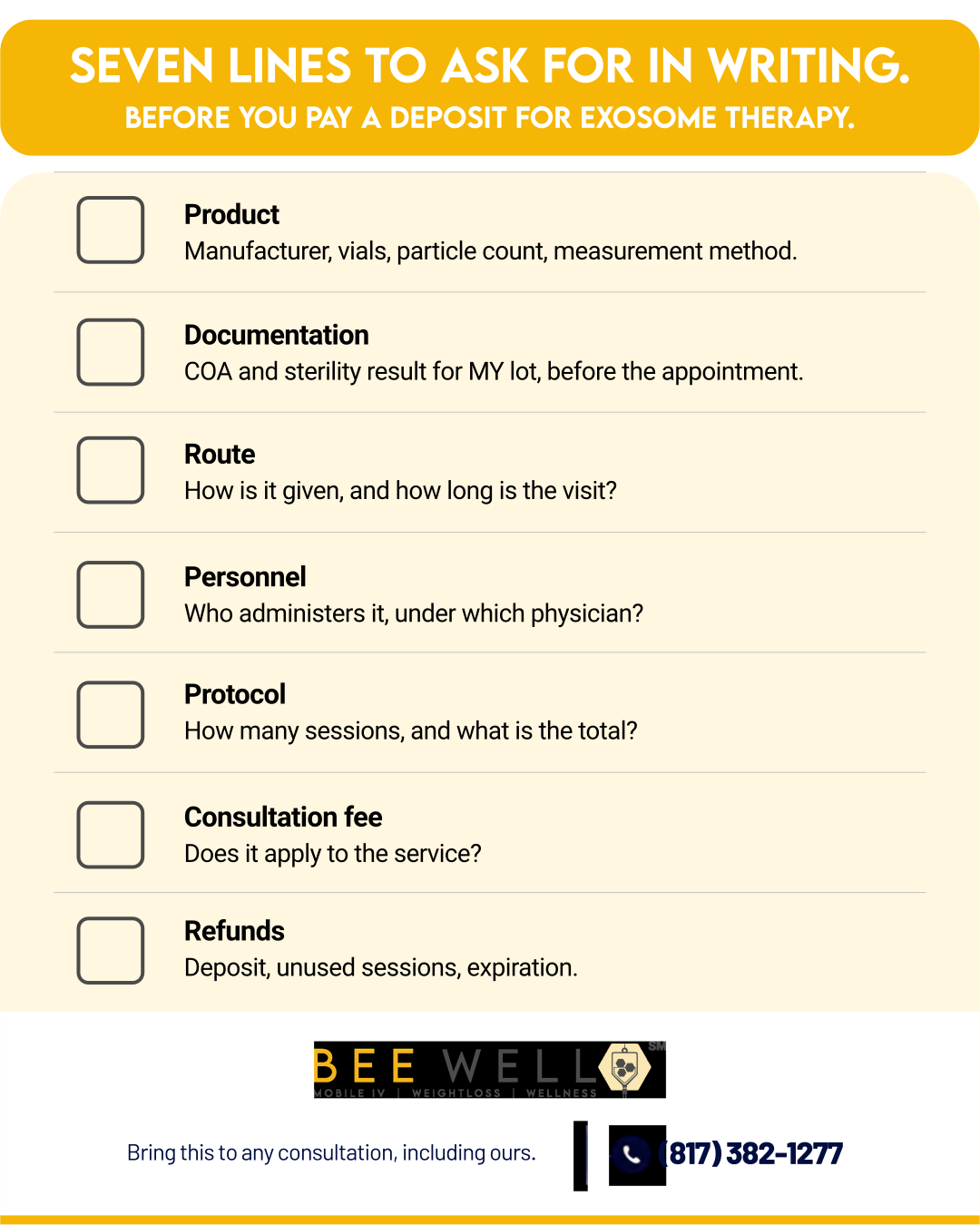
Ask for it in writing, with these lines broken out. Most practices can produce it in a few minutes when asked.
- Product: manufacturer, number of vials, stated particle count, and which measurement method produced that count
- Documentation: whether the certificate of analysis and sterility result for your lot will be available before the appointment
- Route: how it is administered and the expected appointment length
- Personnel: who administers it and under whose physician oversight
- Protocol: how many sessions are recommended, at what interval, and the total for the full course
- Consultation fee: the amount, and whether it applies toward the service
- Refunds: what happens to a deposit or unused sessions, and whether a package expires
A written itemization also gives you something to hand a second provider, which is worth doing at these prices.
What at-home delivery changes about the real cost
Comparing sticker prices alone misses part of what you spend.
A study in the American Journal of Managed Care measured the full time cost of an ambulatory medical visit in the United States: 121 minutes on average, of which 37 minutes is travel and 84 is time at the clinic, with only about 20 minutes of face-to-face physician time. More than 80 percent of visit time is spent on something other than care. The authors calculated an average opportunity cost of $43 per visit, which exceeded the average out-of-pocket payment of $32.
Apply that to a three to six session protocol and you are looking at six to twelve hours and $129 to $258 in time cost that appears on nobody’s quote.
Bee Well℠ delivers regenerative wellness services at your home or office across DFW, Southern Oklahoma, and California. That removes facility overhead on our side and the drive, the parking, and the waiting room on yours. Whether it nets out in your favor depends on your schedule and what you are being quoted, but it belongs in the comparison rather than outside it.
For a concrete local benchmark on what transparent at-home pricing looks like, several DFW mobile IV providers publish full menus, with hydration infusions around $199 and NAD+ protocols around $749, and state their travel-fee policy up front. Mobile providers in this market publish prices. Exosome providers do not. That contrast is not an accident of formatting.
The cost of the alternatives
Two comparisons come up in nearly every consultation.
Local stem cell therapy
One Dallas regenerative clinic does publish prices, and they are useful context: $14,500 for a first treatment, $7,000 for a follow-up at six to twelve months, and $19,000 for spine, neck, and back protocols, which the practice states are never discounted. Its site also states plainly that these protocols are not covered by traditional health insurance.
Treatment abroad
Mexican clinics currently publish packages in the range of roughly $1,650 to $9,500, with the common band between $3,000 and $8,000. A Monterrey package listed at $3,500 bundles 50 million umbilical cord cells, a stated 5 billion exosomes, an NAD+ infusion, and an ultrasound-guided joint injection.
The price gap against a $14,500 domestic quote is real, and so is the follow-up gap. What a package price does not include is what happens if something goes wrong twelve hundred miles from your physician, who provides that care, and who pays for it. Both options involve products without FDA approval. A lower price removes cost, not risk.
For scale on what patients across the country are actually paying, the most rigorous figures available come from peer-reviewed work analyzing direct-to-consumer marketing by these businesses. In one analysis of 38 companies operating or facilitating 60 clinics, the least expensive advertised product cost $2,950, the most expensive was $25,000, and the average listed cost was $11,322.
What the money actually buys at each price point
Since nobody publishes a price ladder, here is the structure behind the numbers you will be quoted, built from verified wholesale pricing and published clinic menus rather than from claims.
| Quote band | What is usually inside it |
|---|---|
| $300 to $800 | An add-on to a procedure you were already having, most often microneedling. Typically a single small vial or a topical application. The base procedure carries its own separate price. |
| $900 to $1,500 | A standalone aesthetic treatment. Product plus the procedure, one session. This is the band verified DFW-area and national clinic menus actually sit in for facial work. |
| $1,500 to $3,000 | Larger product volume, multiple areas, or a session that includes both a device treatment and product. Also where per-session pricing on a multi-session hair protocol tends to land. |
| $3,000 and above | Usually a protocol total rather than a session, or an intravenous administration. Verified published US pricing at this level is essentially nonexistent, so this band is where claimed ranges and real ones diverge most. |
Two things follow. If you are quoted a number in the top band, ask specifically whether it is a session or a course, because that single question changes the comparison by a factor of three. And if a national cost guide told you to expect the top band and you are being quoted the middle one, that is not a red flag. It is the guide being wrong.
The international benchmark, for perspective
Turkish hospitals currently publish exosome treatment prices between roughly $1,000 and $1,500 for dermatology and hair applications, with medical tourism platforms claiming Turkey runs 60 to 80 percent below US and UK pricing. Mexican clinics publish bundled regenerative packages between roughly $1,650 and $9,500.
Those are useful as a sanity check on the claimed US average of around $4,900. They are not a recommendation. A price set in a market with different regulatory oversight, different malpractice exposure, and no continuity of care after you fly home is not the same product at a discount.
The consumer protection backdrop
This is not a hypothetical risk category. In January 2025 the Federal Trade Commission announced that the co-founders of the Stem Cell Institute of America and a network of related companies were banned from marketing stem cell treatments and ordered to pay more than $5.1 million, comprising $3.31 million in consumer refunds and $1.845 million in civil penalties. The companies had sold injections for osteoarthritis, neuropathy, and joint pain at up to $5,000 per injection, often multiple injections per patient.
The FTC’s Bureau of Consumer Protection director described it directly: the defendants “tricked people who needed real medical help into buying expensive, unproven stem cell therapy.” That action did not involve exosomes, which is worth stating plainly, but it establishes the enforcement posture around the category.
The Better Business Bureau’s medical spa guidance is short and useful: a reputable practice “should provide clear and upfront pricing for all services,” and consumers should be wary of hidden fees, unusually low prices, high-pressure sales, and results that sound too good to be true. Review cancellation, refund, and follow-up policies before you pay.
The International Society for Stem Cell Research adds three questions to its patient checklist that belong in any financial conversation: what are the total costs and what do they include, who provides emergency care if something goes wrong, and who pays for it. Its guidance is that patients should not be rushed or financially enticed into a decision.
How we handle pricing at Bee Well℠
We do not publish a price list for regenerative services, and we want to be straight about why rather than hiding behind “every patient is different.”
The honest reason is that the quote genuinely depends on product volume, route, and how many sessions are appropriate, and a headline number would mislead more than it would help. What we will do is give you the itemization above in writing before you pay anything, name our manufacturer, provide lot documentation on request, and tell you when we think the money is better spent elsewhere.
If you have a quote from another DFW provider and cannot tell what is in it, send it to us. We will walk you through what to ask them. There is no obligation to book anything with us, and we have talked people out of treatment on that call more than once.
References
- Internal Revenue Service. Publication 502, Medical and Dental Expenses. Revised February 5, 2026. irs.gov
- Internal Revenue Service. Frequently asked questions about medical expenses related to nutrition, wellness and general health. March 17, 2023. irs.gov
- Internal Revenue Service. IR-2024-65: IRS alert on companies misrepresenting nutrition, wellness and general health expenses as medical care. March 6, 2024.
- Consumer Financial Protection Bureau. Medical Credit Cards and Financing Plans. May 2023. consumerfinance.gov
- Federal Trade Commission. Stem Cell Institute Co-Founders and Companies Banned from Marketing Stem Cell Treatments and Ordered to Pay More Than $5.1 Million. January 8, 2025. ftc.gov
- Vestad B, Llorente A, Neurauter A, et al. Size and concentration analyses of extracellular vesicles by nanoparticle tracking analysis: a variation study. J Extracell Vesicles. 2017;6(1):1344087.
- Bachurski D, Schuldner M, Nguyen PH, et al. Extracellular vesicle measurements with nanoparticle tracking analysis: an accuracy and repeatability comparison between NanoSight NS300 and ZetaView. J Extracell Vesicles. 2019;8(1):1596016.
- Poudel S, Nelson DL, Yen JH, et al. Intermethod Characterization of Commercially Available Extracellular Vesicles as Reference Materials. Biomolecules. 2025;16(1):66.
- Welsh JA, Goberdhan DCI, O’Driscoll L, et al. Minimal information for studies of extracellular vesicles (MISEV2023). J Extracell Vesicles. 2024;13(2):e12404.
- Ray KN, Chari AV, Engberg J, et al. Opportunity Costs of Ambulatory Medical Care in the United States. Am J Manag Care. August 2015.
- Turner L, Martinez JR Jr, Najjar S, et al. Businesses marketing purported stem cell treatments and exosome therapies for COVID-19: An analysis of direct-to-consumer online advertising claims. Stem Cell Reports. 2023;18(11):2010-2015.
- Texas Occupations Code Chapter 702 (Health Spa Act); 1 Texas Administrative Code Chapter 102. Texas Secretary of State.
- Better Business Bureau. BBB Tip: What You Should Know Before You Visit a Med Spa. May 31, 2024. bbb.org
- International Society for Stem Cell Research. What should I ask before considering an unproven stem cell treatment? aboutstemcells.org
DISCLAIMER
This content is for educational purposes only and does not constitute medical advice. It is not a substitute for consultation with a qualified healthcare provider. No exosome product is approved by the U.S. Food and Drug Administration, and individual results cannot be predicted or guaranteed.
If you develop fever, spreading redness, worsening pain, or difficulty breathing after any injection or infusion, seek emergency care immediately rather than waiting to reach the practice that treated you. Call 911 for a medical emergency.