



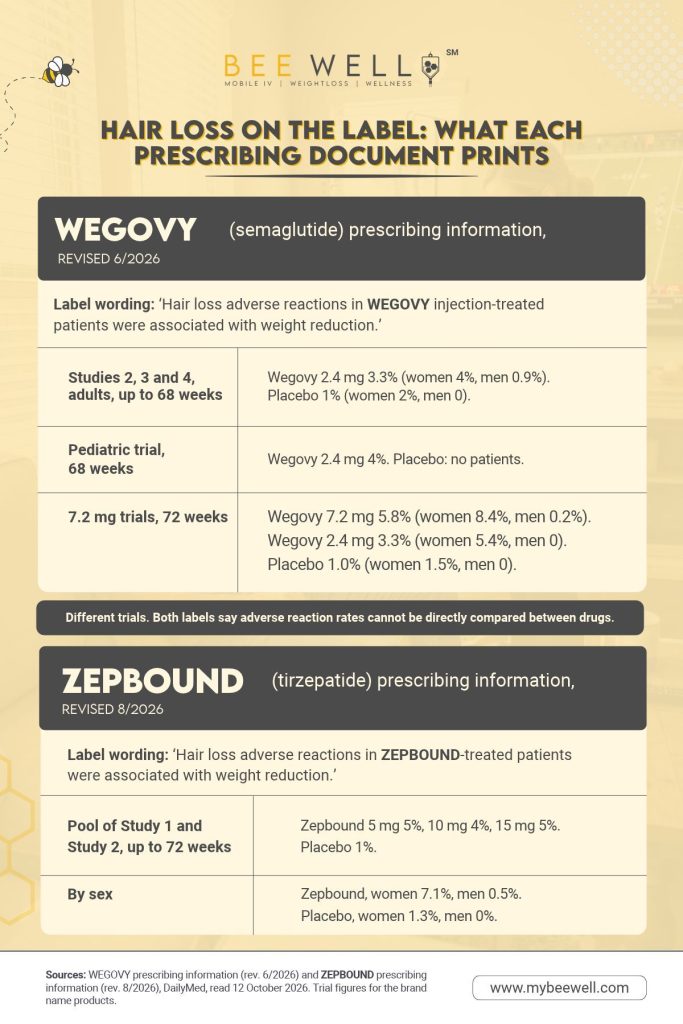
Yes, hair loss is printed on the current FDA labels for both Wegovy (semaglutide) and Zepbound (tirzepatide), and both labels describe the reports as “associated with weight reduction.” In the main Wegovy trials, it was reported by 3.3% of adults on 2.4 mg and 1% on placebo. The Zepbound label reports it for 7.1% of women and 0.5% of men, against 1.3% and 0% on placebo. Those are two separate sets of trials, and neither label says one drug is easier on hair than the other.
TL;DR
Semaglutide hair loss is a labeled adverse reaction, not a rumor. The Wegovy prescribing information, revised June 2026, reports hair loss in 3.3% of adults on 2.4 mg against 1% on placebo, and in 5.8% on the 7.2 mg dose in a separate pair of trials. The Zepbound prescribing information, revised August 2026, reports it in 7.1% of women and 0.5% of men on tirzepatide, against 1.3% and 0% on placebo.
Both labels tie the reports to weight reduction, and both warn that rates from different drugs’ trials cannot be directly compared. Neither label says when the hair loss started, how long it lasted, or whether the hair came back. The American Academy of Dermatology lists losing 20 pounds or more as a known trigger for temporary shedding.
Does Semaglutide Cause Hair Loss According to the Wegovy Label?
The Wegovy label lists hair loss among its most common adverse reactions and reports it more often on semaglutide than on placebo in every trial pool it describes. The WEGOVY prescribing information on DailyMed, revised 6/2026, states: “Hair loss adverse reactions in WEGOVY injection-treated patients were associated with weight reduction.” Here is every hair figure that the label prints.
| Trials on the Wegovy label | Arm | All patients | Women | Men |
|---|---|---|---|---|
| Studies 2, 3 and 4, adults, up to 68 weeks | Wegovy 2.4 mg | 3.3% | 4% | 0.9% |
| Studies 2, 3 and 4, adults, up to 68 weeks | Placebo | 1% | 2% | 0 |
| Pediatric trial, aged 12 and older, 68 weeks | Wegovy 2.4 mg | 4% | Not broken out | Not broken out |
| Pediatric trial, aged 12 and older, 68 weeks | Placebo | No patients | Not broken out | Not broken out |
| 7.2 mg trials, adults with obesity, 72 weeks | Wegovy 7.2 mg | 5.8% | 8.4% | 0.2% |
| 7.2 mg trials, adults with obesity, 72 weeks | Wegovy 2.4 mg | 3.3% | 5.4% | 0 |
| 7.2 mg trials, adults with obesity, 72 weeks | Placebo | 1.0% | 1.5% | 0 |
The first pool covered 2,116 adults on Wegovy 2.4 mg and 1,261 on placebo. The label gives the baseline mix as 71% female, so the all-patient figure leans toward the women’s rate.
For the 25 mg tablet, the label prints no separate hair figure. It says only that the types and frequency of common adverse reactions in the tablet trial were similar to the 2.4 mg injection table.
What changed with the 7.2 mg dose
The 7.2 mg rows are the newest part of that table. The label allows up to 7.2 mg weekly for adults who have tolerated 2.4 mg for at least four weeks, when the prescriber judges that more weight reduction is clinically indicated. Its safety data for that dose come from two 72-week trials with 1,311 people on 7.2 mg, 304 on 2.4 mg, and 303 on placebo.
Inside those two trials, hair loss was reported more often on the higher dose. It is also the only place on either label where a patient on the medication changed treatment over it. One event in the 7.2 mg group led to permanent discontinuation, one to a temporary interruption, and five to a dose reduction. None of those actions were taken in the 2.4 mg or placebo groups.
What the Zepbound Label Reports for Tirzepatide
Zepbound’s label also places hair loss among its most common adverse reactions, the ones reported in at least 5% of patients. The ZEPBOUND prescribing information on DailyMed, revised 8/2026, uses nearly the same sentence as the semaglutide label: hair loss adverse reactions in Zepbound-treated patients “were associated with weight reduction.”
The figures come from a pool of two placebo-controlled trials, Study 1 and Study 2, which treated 2,519 adults for up to 72 weeks. The label prints them two ways, by dose and by sex.
| Pool of Study 1 and Study 2 | Hair loss reported |
|---|---|
| Placebo (958 patients) | 1% |
| Zepbound 5 mg (630 patients) | 5% |
| Zepbound 10 mg (948 patients) | 4% |
| Zepbound 15 mg (941 patients) | 5% |
| Women on Zepbound | 7.1% |
| Men on Zepbound | 0.5% |
| Women on placebo | 1.3% |
| Men on placebo | 0% |
Two details are easy to miss.
The rounded figures do not climb from 5 mg to 15 mg in that table. And the label states that no Zepbound-treated patient stopped study treatment because of hair loss, while one placebo-treated patient did.
Two Labels, Two Sets of Trials, No Ranking
It is tempting to line the two tables up and pick a winner. The labels themselves tell you not to. Each opens its adverse reactions section with the same caution: rates observed in the clinical trials of a drug “cannot be directly compared” to rates in the trials of another drug “and may not reflect the rates observed in practice.”
The Wegovy label gives a neat demonstration of why. Semaglutide 2.4 mg appears in it twice. In one pool of trials, 4% of women on that dose reported hair loss. In the 7.2 mg trials, 5.4% of women on the very same dose did.
Same drug, same dose, different trials, different numbers.
If two readings for one dose of one drug don’t match, a gap between two different drugs tested in separate trials tells you very little.
A few differences in how the trials were built, all taken from the labels:
- The main Wegovy pool ran up to 68 weeks. The Zepbound pool and the Wegovy 7.2 mg trials ran 72 weeks.
- Zepbound’s hair paragraph reports results by sex only. Wegovy’s reports an overall figure and a split.
- These are weight management figures for the brand-name, FDA-approved products at their labeled doses. We have not carried anything over from labels written for other uses or other products.
So we don’t tell patients that one of these medications is gentler on hair. The labels don’t support that sentence, and for a fuller picture of how the two differ, we keep a separate page on the differences between semaglutide and tirzepatide.
What Does “Associated With Weight Reduction” Mean?
It means the label links the hair loss reports to the weight that trial participants lost. It does not mean the label has ruled the drug in or out as a direct cause. Neither label prints the analysis behind the phrase.
The placebo rows are worth a second look here. People on placebo reported hair loss too: 2% of women in the main Wegovy pool and 1.3% of women in the Zepbound pool. Those participants were not on the drug, but they were not living normally either. According to the same labels, everyone in most of these trials was coached toward a daily deficit of about 500 calories and at least 150 minutes of weekly activity. One Wegovy trial opened with eight weeks on 1,000 to 1,200 calories a day.
Shedding after weight loss is not unique to these medications. The American Academy of Dermatology’s patient page on hair shedding and hair loss lists “Lost 20 pounds or more” as the first of several stressors that commonly bring on excessive shedding. Giving birth, high fever, an operation, and prolonged stress are on the same list.
Shedding or Hair Loss: How Dermatologists Tell Them Apart
The word on both labels is “hair loss.” Dermatologists split that into two different things, and the split matters because they behave differently.
The Academy describes it this way. Losing 50 to 100 hairs a day is normal. When the body sheds far more than that, the medical term is telogen effluvium, or excessive hair shedding. Hair loss in the stricter sense, anagen effluvium, happens when something stops the hair from growing.
| Excessive shedding | Hair loss | |
|---|---|---|
| Medical term the Academy uses | Telogen effluvium | Anagen effluvium |
| What is happening | More hair than usual falls out | Something stops hair from growing |
| Causes the Academy lists | Losing 20 pounds or more, childbirth, high fever, surgery, illness, heavy stress | Heredity, an overreacting immune system, some drugs and treatments, tight hairstyles, harsh products |
| Usual course, per the Academy | Often stops on its own as the body readjusts | Hair does not grow until the cause stops |
On timing, the same page says most people notice the shedding a few months after the stressful event. It adds that as the body readjusts, the shedding stops, and that within six to nine months the hair tends to regain its normal fullness.
Read that carefully before taking comfort from it. It describes what usually follows a single event that has ended. The Academy also says that if the stressor stays with you, shedding can be long-lived, and that some people have shedding and hair loss at once. Someone still losing weight month after month is not in the simple version of that story.
Nothing on that page, and nothing on this one, can tell you which pattern is yours.
Why the calendar confuses people
Here is a detail that gets lost when people compare notes online. The Wegovy label’s dose schedule takes sixteen weeks to climb: 0.25 mg for weeks 1 through 4, then 0.5 mg, 1 mg, and 1.7 mg for four weeks each, with the maintenance dose from week 17. On that schedule, a person three months in is on 1 mg, well below the 2.4 mg that the label’s percentages describe.
The label figures cover trials of 68 to 72 weeks, and they do not say in which month the reports came in. Sixteen of those weeks in the 2.4 mg trials are the climb, and the rest are at the full dose. So a label percentage cannot tell you whether what you see in the shower in month three is early, late, or typical. It is a count taken across the whole trial, and your third month is one small slice of that.
Why Are the Reported Rates So Much Higher in Women?
Neither label explains it. They simply report the gap: 4% of women against 0.9% of men on Wegovy 2.4 mg in the main pool, and 7.1% against 0.5% on Zepbound. The same lopsided pattern shows up on placebo.
We could offer theories, and you will find plenty online. None of them is on the label, so we will leave it at what was measured.
What a Clinician Usually Checks First
The first job is finding the cause, and that starts with questions. The Academy’s diagnosis page says a dermatologist will ask how long the hair loss has been going on and whether it came on quickly, look closely at the scalp and nails, and gently pull on the hair to see how it is growing and whether it breaks. If a disease, vitamin deficiency, hormone imbalance, or infection is suspected, a blood test or scalp biopsy may follow.
That same page carries a warning worth repeating. It says biotin, iron, or zinc should only be taken when a blood test shows a deficiency, because taking a supplement when levels are normal can be harmful.
Cause first. Bottle second, if at all.
Before a visit, it helps to have these written down. They are observations to bring, not instructions:
- The month you started the medication, and the dose you are on now
- When you first noticed more hair in the brush or the drain
- Roughly how much weight you have lost, and how quickly
- Whether the thinning is all over or in one area, and whether the scalp itches, burns or looks red
- Anything else that changed in the same months: an illness, surgery, a new medication, a stopped birth control pill, a hard stretch at work or home
- Whether hair loss runs in your family
Who should hear it first? The prescriber who manages your medication, and soon. The medication guides for Wegovy and Zepbound each say to talk to your healthcare provider about any side effect that bothers you or does not go away.
Do not stop the medication on your own to test a theory.
The Academy is blunt about this for any drug suspected of causing hair loss: talk with the doctor who prescribed it first, because stopping some medications abruptly can cause serious problems. We cover what coming off these medications involves in our piece on whether GLP-1 therapy has to be permanent.
How that works for our patients in North Texas
Our weight loss care runs by telehealth, so a patient in Fort Worth, Frisco, or Denton receives the same way: by phone, by text, or on a telehealth check-in. Side-effect questions are handled through those channels, and lab needs are assessed at the first consultation. The Fort Worth version of our program lays out the steps.
A weight loss check-in is not a scalp exam. If the pattern sounds like something other than all-over shedding, the honest next step is a board-certified dermatologist near you.
What the Labels and the Research Still Cannot Tell You
Quite a lot, and a page that hides this is selling certainty it doesn’t have. The labels do not say:
- When during treatment the hair loss was reported
- How long it lasted
- Whether the hair grew back, on the drug or after it
- What kind of hair loss it was, since “hair loss” is the reported term and not a dermatologist’s diagnosis
- Whether the drug itself contributes beyond the weight loss it produces
The published research has not closed those gaps. A 2026 commentary in Dermatology and Therapy Piraccini and colleagues reviewed the evidence and wrote that most of it comes from safety-reporting databases and look-back studies of medical records, that no prospective, controlled study has been designed to answer the question, and that “causality has not been established.”
The authors add that further studies are needed to confirm whether hair regrows if the drug is stopped. One caution on the source itself: two of its five authors are employed by a dermo-cosmetics company, which also funded the commentary. We have used its summary of the evidence and left its recommendations out.
Label percentages also describe trial volunteers on the brand-name products at fixed doses. As the labels themselves say, they may not reflect the rates seen in everyday practice.
Where Hair Treatments Fit, and Where They Don’t
A side effect page that ends in a sales pitch deserves your suspicion, so this section is short. We do offer hair treatments, and we have written plainly about what PRP and exosomes can and cannot do for thinning hair, including that no exosome product is FDA-approved. No treatment belongs in the conversation until someone has worked out why the hair is falling.
Hair is one of three changes that tend to come up once weight is coming off quickly. The other two have their own pages: loose skin after losing weight fast and what the research says about muscle on GLP-1 therapy.
Bring the Hair Timeline to Your Prescriber
If you are finding more hair than usual, write down the dates: when the medication started, when the shedding started, and how much weight came off in between. Then tell the person who prescribes your medication, and ask whether a dermatologist should take a look. That is a better use of a week than a supplement aisle or a forum thread.
If you live in Fort Worth, Frisco, Denton, or elsewhere in our Texas service area and want supervised care where this kind of question gets a straight answer, our medical weight loss program starts with a 15-minute telehealth consultation. At Bee Well, we won’t promise that your hair stays put, or that it returns on a schedule. We will tell you what the labels report, and what they leave out.