



The headlines arrived faster than the evidence did. Somewhere between the first viral post and the tenth, “you lose muscle on these medications” hardened into a warning, and people who were doing well on a supervised programme started wondering whether they were quietly damaging themselves.
TL;DR
Lean body mass does fall during weight loss on incretin-based medications, and a 2026 review in Nutrients that synthesised randomised trials and observational studies states it plainly. The same review states something the headlines left out: that lean mass loss is generally proportional to the size of the weight loss, and should not be read as a direct stand-in for skeletal muscle loss or for the drug damaging muscle. That distinction is the whole subject. The review also found that tirzepatide appears to improve muscle composition by reducing fat infiltration in muscle, while semaglutide showed more mixed effects on strength and physical performance, particularly in older or frailer people. The evidence points not toward stopping treatment but toward attending to what surrounds it: adequate protein, resistance exercise, and actually measuring function rather than assuming. The FDA-approved labelling for tirzepatide already frames the medication as something used in combination with a reduced-calorie diet and increased physical activity, which is the same conclusion arrived at from the regulatory side.
This page describes what published research reports. It is not medical advice; it does not recommend or adjust any medication, and nothing here should be acted on without your own prescriber.
What “Lean Mass” Actually Measures
Most of the confusion in this conversation comes from one word doing two jobs.
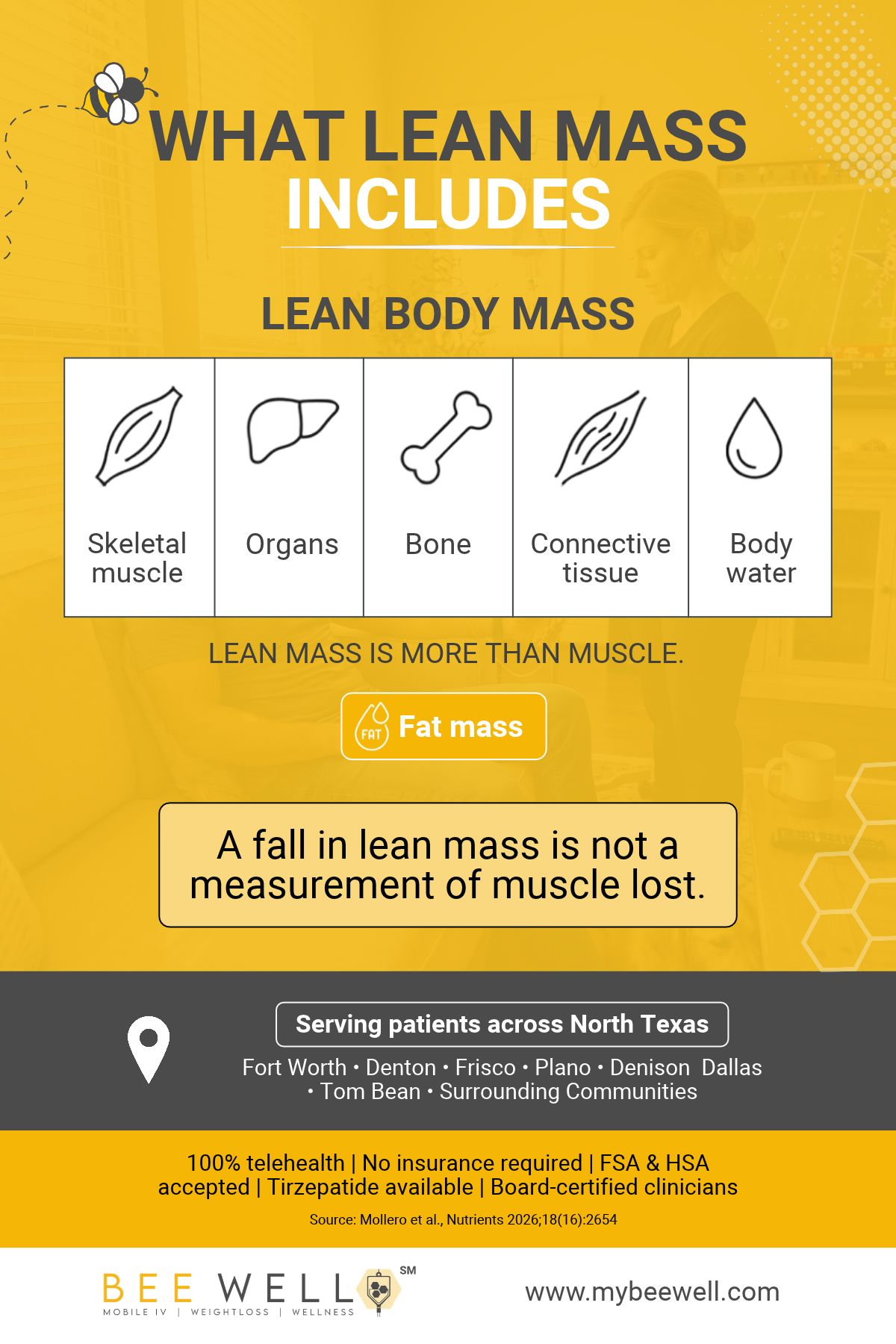
Lean body mass is everything that is not fat mass. That includes skeletal muscle, but it also includes organs, bone, connective tissue, and the water held in all of it. When someone loses a substantial amount of weight, several of those components change, and a scan that reports a drop in lean mass is not reporting that a specific quantity of muscle has gone.
This is why the review’s phrasing matters so much. Writing in Nutrients in August 2026, Mollero and colleagues reviewed randomised controlled trials and observational studies on semaglutide and tirzepatide, and concluded that both produce substantial weight loss accompanied by reductions in lean body mass, while stating that current evidence indicates this loss is generally proportional to the magnitude of the weight loss and should not be interpreted as a direct surrogate for skeletal muscle loss or drug-induced myotoxicity. The full paper is available as Beyond Weight Loss: Skeletal Muscle Health During Incretin-Based Therapy in Patients with Diabesity.
Read that carefully, because it cuts both ways. It does not say lean mass is preserved. It says the fall tracks the size of the weight loss, and that calling it muscle damage goes beyond what the data supports.
Why proportionality matters
Any substantial weight loss, by any method, reduces lean mass to some degree. A smaller body needs less of the tissue that supports and moves it, and that is true of dietary weight loss and surgical weight loss as well.
So the question worth asking is not whether lean mass falls. It is whether it falls more than the weight loss would predict, and whether function is affected. Those are different questions from the one the headlines asked, and they are the ones the research is actually pursuing.
Where the Two Medications Differ
The review found the picture is not uniform across drugs, which is one of its more useful findings and one that rarely survives into a summary.
| Finding reported | What the review describes |
| Tirzepatide | Appears to improve skeletal muscle composition by reducing muscle fat infiltration |
| Semaglutide | Shows more heterogeneous effects on muscle strength and physical performance, particularly in older or frail individuals |
| Both | Substantial weight loss accompanied by reductions in lean body mass |
Muscle fat infiltration is worth explaining, because it is the part that suggests quality can improve while quantity falls. Fat accumulating within and between muscle fibres is associated with poorer muscle function, and a reduction in it is a change in the character of the tissue rather than its mass. Two people can lose the same amount of lean mass and end up with muscle that performs differently.
The review is careful about how far this goes. It describes functional outcomes and data in older adults as remaining limited, which is an honest statement about the size of the evidence base rather than a conclusion about safety.
What the Evidence Points Toward Doing
Here the review is more constructive than the headlines it is correcting.
It highlights muscle quality, nutritional adequacy and resistance exercise as key determinants of muscle preservation during incretin-based therapy, and concludes that preserving skeletal muscle health should be treated as a central part of obesity management, through individualised nutritional care, adequate protein intake, resistance exercise and regular functional assessment.
Notice what is not on that list. Stopping the medication is not among the recommendations, and neither is any particular supplement or product.
Notice also the fourth item, because it is the one that gets skipped. Regular functional assessment means finding out whether someone can actually do the things that matter, rather than inferring it from a body composition number. A scan describes tissue. Standing up from a chair, carrying shopping, and climbing stairs describe function, and they are what a person notices.
The label already says most of this
There is a second source that arrives at a similar place from an entirely different direction.
The FDA-approved prescribing information for tirzepatide, published as the ZEPBOUND label on DailyMed, states that it is indicated in combination with a reduced-calorie diet and increased physical activity to reduce excess body weight and maintain weight reduction long term in adults with obesity, or adults with overweight in the presence of at least one weight-related comorbid condition.
That phrase is not decorative. Diet and physical activity are written into what the medication is approved to do, which means a programme that supplies only the prescription is not delivering what the labelling describes. The research conclusion and the regulatory framing point the same way.
How a Proportional Finding Became a Warning
It is worth understanding how this got loud, because the shape of the error tells you what to watch for next time.
The underlying observation is real and unsurprising: people losing a lot of weight lose some lean mass along with fat. That has been true of every effective weight loss method studied. When it was measured in trials of these medications, the finding travelled outward through summaries, and at each step a qualifier fell away.
“Lean mass falls in proportion to weight lost” became “lean mass falls”. That became “muscle is lost”. That became “these drugs waste your muscle”. The first statement is what the research says. The last one is a claim about mechanism that the review explicitly declines to make, because proportional loss and drug-induced muscle toxicity are different things and only one of them is supported.
There is also a commercial engine underneath it. A worry about muscle loss sells protein powders, amino acid blends, supplements and programmes, so the alarming version of the story has people funding its distribution while the qualified version does not.
None of which means the question is silly. Lean mass genuinely does fall, function genuinely does matter, and the review is clear that data on older adults and on functional outcomes is still limited. The correct response to a real question badly reported is a better answer, not a dismissal.
The two things worth watching in yourself
Neither requires equipment, and both are more informative than a number from a scan.
The first is capability. Whether you can still do the things you could do three months ago- carrying, climbing, standing up from low chairs- is the measure the review points at when it calls for regular functional assessment. A change there is worth reporting to whoever prescribes for you.
The second is how the loss is being achieved. Very rapid loss, minimal protein, and no resistance work is a different situation from steady loss with both in place, even on identical medication at an identical dose. That difference is inside your control in a way the medication’s effects are not.
The Questions Worth Asking Your Prescriber
We are not your prescriber, and this section is deliberately a list of questions rather than answers.
- How is my protein intake being assessed, and is it adequate for my body size and rate of loss
- What resistance training is realistic for me, and how would we build it up
- What functional measures are we tracking, and how often
- What would count as a signal that something needs to change
- Does my age or baseline muscle reserve change any of the above
That last one is there because the review names age, baseline muscle reserve, nutritional status, and physical activity as factors that influence how incretin therapies affect skeletal muscle. Two people on the same medication are not in the same situation.
Baseline muscle reserve deserves a sentence of its own, because it is the factor people rarely think to raise. Someone who arrives with more muscle than average has more margin than someone who does not, and the same proportional loss lands differently on the two of them. That is not a reason for anyone to be discouraged from treatment. It is a reason the conversation should be individual rather than generic, which is what the review means by individualised nutritional care.
Age interacts with the same point. The review is specific that data in older adults remains limited and that semaglutide showed more mixed effects on strength and physical performance, particularly in older or frail individuals, and it is honest enough to present that as an open question rather than a settled finding. If you are older, that is worth naming in the appointment rather than assuming the general picture applies to you unchanged.
None of this changes what the medication does. It changes how closely the surrounding parts deserve attention, and who should be watching them.
What This Does Not Tell You
Being clear about the limits is part of reporting the research honestly.
The review is a narrative review, meaning it synthesises the literature rather than pooling results statistically, and it says outright that functional outcomes and data in older adults remain limited. It is a description of where the evidence stands in 2026, not a final answer.
It also does not address individual circumstances. Nothing in it tells you whether a change you have noticed in yourself is expected, concerning, or unrelated, and no article can. If you are experiencing weakness, difficulty with everyday tasks, or a change you did not anticipate, that is a conversation with a clinician rather than something to resolve from reading.
And it says nothing about dosing, about starting or stopping, or about whether any particular person should be on any particular medication. Those decisions sit with your prescriber and with you.
How We Approach It in a Supervised Programme
This section describes our own approach rather than a research finding.
Weight loss handled well is not only a number going down. Protein intake, activity, and how someone is actually functioning are part of the conversation from the start rather than added when something goes wrong, and that is the same shape the review describes when it calls muscle preservation a central part of obesity management rather than an afterthought.
Being supervised is the practical difference. Somebody is looking at more than the scale, questions get asked before they become problems, and there is a clinician to raise a concern with rather than a search bar. Our page on doctor supervised weight loss programs sets out what that involves, and what to expect during a supervised programme covers the process.
If you are earlier in the decision, how medical weight loss works is the starting point, and we have written separately on the differences between semaglutide and tirzepatide and on whether GLP-1 therapy is permanent.
Bring the Muscle Question to Your Next Review
If the headlines have been worrying you, the useful move is to raise it at your next appointment with the specific questions above rather than to change anything on your own. Bee Well runs supervised medical weight management, and the muscle conversation belongs inside that supervision rather than outside it.