



Medical weight loss in Fort Worth is a program run by trained clinicians who look at your health history, lab work, and goals, then build a plan around your body instead of a one-size-fits-all diet. It usually combines nutrition guidance, lifestyle coaching, and, when appropriate, prescription medications like GLP-1 options. The big difference from a crash diet is oversight. A clinician tracks your progress, checks your safety, and adjusts the plan at regular visits. Your first appointment is mostly a conversation. You share your history, talk through what you have already tried, and review options. There is no instant fix here. The goal is steady, health-focused change you can keep. If you carry extra weight that affects how you feel or move, or past diets have not stuck, this approach is worth a closer look.
Why Do Diets Keep Failing While Clinics Get Results?
Most fad diets fail because they ignore your biology. They hand you a rigid rulebook and assume willpower alone will carry you. It rarely does. When you cut calories hard, your body fights back by slowing metabolism and ramping up hunger hormones. That is not a character flaw. It is physiology doing its job.
A structured program treats those signals as data, not enemies. Instead of guessing, a clinician can run labs, spot issues like thyroid problems or insulin resistance, and address the real reason the scale will not budge. That is the gap between trying harder and getting actual support. People searching for things like why tirzepatide stopped working or whether a medication quits after a while are bumping into the same truth. Weight is complicated, and managing it well takes monitoring, not just motivation.
There is also a feedback loop that most diets never account for. Each time a restrictive plan ends in regain, the next attempt starts from a harder place. Your set point can drift upward, your trust in your own effort erodes, and the cycle repeats. A program built on measurement breaks that loop by replacing self-blame with a plan that responds to what your body is actually doing. When the scale stalls, the question stops being “what did I do wrong” and becomes “what does the data say we should change next?”
What Does “Medically Supervised” Actually Mean?
Medically supervised weight loss means a licensed clinician is involved from start to finish, not just at the sign-up. They evaluate you, design the plan, monitor your response, and change course when your body needs it. You are never handed a bottle and sent off alone.
In practice, supervision covers a few things. First, screening. A clinician reviews your medical history, current medications, and any conditions that change what is safe for you. Second, lab work.
Bloodwork gives a baseline and flags issues that diet alone cannot fix. Third, a treatment plan tailored to you, which might include nutrition targets, movement, and prescription medication if it fits your situation. Fourth, follow-up. You check in on a schedule so someone trained is watching your numbers, your side effects, and your results.
That oversight is the whole point. Medications in this category are powerful and effective, but they work best when someone is paying attention to dosing, hydration, and how they actually feel week to week. Supervision turns a blunt tool into a precise one.
It also means someone is accountable for the medical side of your care. If a lab value shifts, if a side effect lingers, or if a different prescription you start could clash with your plan, a clinician is positioned to catch it. That is a different relationship than buying a supplement online or following an influencer’s protocol. The person guiding you carries training and a duty to put your safety first.
How Is This Different From DIY Dieting?
The short version: DIY dieting puts the entire load on you, while a supervised program shares it with someone who has training and tools. That changes the odds.
On your own, you guess at portions, copy a plan from the internet, and have no way to know if a stall means you need patience or a real adjustment. There is no one to call when an approach stops working, or a side effect shows up. You also have no access to prescription options that can make a real difference for some people.
In a supervised setting, the guesswork shrinks. Here is how the two stack up:
- Personalization. DIY plans are generic. A clinical plan is built from your labs, history, and goals.
- Safety. On your own, you have no screening. A clinician checks for conditions and drug interactions before anything starts.
- Tools. Diet apps cannot prescribe. A clinic can offer medications like semaglutide, tirzepatide, or newer options when appropriate.
- Adjustment. When a DIY diet stalls, you are stuck. In a program, your plan gets revised based on what the data shows.
- Accountability. A standing check-in keeps you moving when life gets busy.
- Cost clarity. DIY spending hides in supplements, meal kits, and restarts. A program lays out what you pay for and why.
None of this means the work disappears. You still make daily choices about food and movement. The difference is that you are not doing it blind or alone. Think of it like the difference between reading about a sprained ankle online and having a trainer watch you move, test the joint, and tell you exactly what to do next. Information is free everywhere. Judgment applied to your specific case is what you are actually paying for.
What Is the Role of Clinician Oversight and Check-Ins?
Clinician oversight is the engine that keeps a program safe and working. The regular check-in is where that oversight happens, and it does far more than weigh you.
At a typical follow-up, a clinician reviews your progress against your goals, asks about energy, sleep, appetite, and any side effects, and looks at whether your current plan still fits. If you started a medication, this is when dosing gets fine-tuned. Many people do best with a slow, stepped increase rather than jumping to a high dose, and that pacing is exactly what supervision manages.
Check-ins also catch the moment when something needs to change. A common question we hear is whether a medication can stop working over time. The honest answer is that results can plateau for several reasons, including dose, habits, and how your body adapts. A clinician can sort out which one is at play and respond, whether that means adjusting the plan, addressing nutrition gaps, or talking through other options. You can read more about that pattern in our guide on when tirzepatide stops working.
Side effects are part of the conversation, too. Some people notice headaches, trouble sleeping, or stomach upset early on. These are usually manageable, and having a clinician to talk to means you are not toughing it out or quitting in frustration. Our articles on semaglutide and insomnia and semaglutide and headaches walk through what to expect and when to raise a flag.
How often these check-ins happen tends to depend on where you are in the process. Early on, when a dose is being set or a new habit is taking hold, visits may sit closer together, sometimes every two to four weeks. Once you find a steady rhythm and your numbers hold, the gap between visits often stretches out. Many of these touchpoints can happen by phone or video, which keeps support close without forcing you to rearrange your week. The cadence is not arbitrary. It tracks how much your body is changing at a given moment.
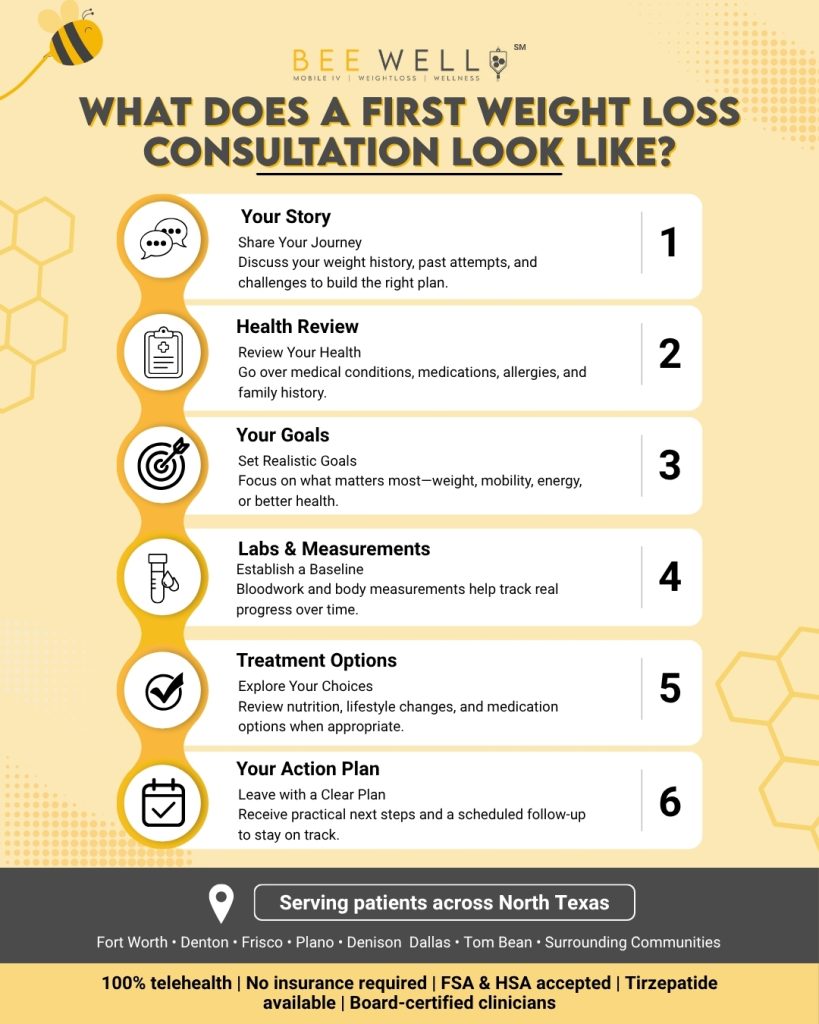
What Does a First Weight Loss Consultation Look Like?
Your first weight loss consultation is mostly talking and listening. Expect a relaxed, thorough conversation rather than a sales pitch or a lecture about willpower.
Here is the general shape of a first visit:
- Your story. You share your weight history, what you have tried, how those attempts went, and what gets in the way. Be honest here. The more your clinician knows, the better the plan.
- Health review. You go over current conditions, medications, allergies, and family history. This is the safety screen that shapes everything else.
- Goals. You talk about what you actually want. Maybe it is a number, maybe it is fitting your clothes, moving without pain, or getting a lab value back in range.
- Labs and measurements. Many programs order bloodwork and take baseline measurements so progress can be tracked against real data.
- Options. Your clinician explains the paths that fit you. That might be nutrition and lifestyle alone, or a plan that includes medication. You discuss how each works, the likely timeline, and what it asks of you.
- A starting plan. You leave with clear next steps and a follow-up scheduled, not a vague promise.
There is no pressure to commit to anything on the spot. A good consult leaves you better informed, even if you decide to wait. The point is to match the plan to the person sitting in the room.
It helps to come prepared. Bringing a current list of your medications and supplements, a rough timeline of past diet attempts, and any recent bloodwork can make the first visit far more useful. Jot down the questions that have been nagging you, too, whether that is about cost, side effects, or how long you might stay on a plan. A first visit usually runs somewhere between thirty and sixty minutes, so a little prep means more of that time goes toward your actual situation rather than filling out background.
Setting Realistic, Health-Focused Expectations
Realistic expectations are what separate a plan that sticks from one that burns out. The goal of a sound program is steady progress and better health markers, not a dramatic number on a crash timeline.
Sustainable weight loss tends to be gradual. Losing roughly one to two pounds a week is a common, sensible pace, though your clinician will set targets that fit your body and situation. Faster is not always better, and rapid loss often comes back. The numbers that matter go beyond the scale, too. Better blood pressure, improved blood sugar, more energy, and easier movement are real wins, even in weeks when the scale is quiet.
Medications can help, but they are tools inside a bigger plan, not magic. They work best alongside food and movement changes you can actually maintain. And plateaus are normal. They are not failures. They are a signal that the plan may need a tweak, which is exactly why ongoing supervision matters.
It also helps to think in months, not days. The first few weeks often bring water-weight shifts that can swing the scale in either direction and tell you very little about real progress. Trends measured over four to twelve weeks carry far more meaning. Many people find it steadier to track how clothes fit, how far they can walk without winding down, or how their labs move at the next draw. Picking one or two of these non-scale markers gives you something honest to hold onto on the days the scale refuses to cooperate.
A word on the buzzy options people ask about. New medications keep arriving, and curiosity about how they compare, like retatrutide versus older choices, is everywhere right now. These are promising, but the right answer is always individual. What works beautifully for one person may not suit another, and only a clinician who knows your full picture should make that call. If you want background reading, our overview of retatrutide for weight loss covers the basics.
Is Medical Weight Loss a Fit for You?
This approach tends to fit people who have struggled with diets on their own, who carry weight that affects their health or daily life, or who want a plan with real oversight instead of guesswork. If that sounds like you, a conversation is the natural next step.
It is also a fit if you have questions you cannot answer alone, like whether a medication is safe with your other prescriptions, or why a past attempt stalled. Some people in the broader DFW area pair their weight program with other wellness support, such as IV hydration therapy, to feel their best as they make changes. That is a personal choice your clinician can help you think through.
What matters most is that you start with a real evaluation. When I sit down with someone for the first time, the goal is to understand their whole picture before suggesting anything. If you are weighing your options for a weight loss clinic DFW residents can rely on, the best move is to book a visit and ask your questions directly.
Ready to Take the Next Step?
If past diets have not stuck and you want a plan with real clinician support, a single consult can tell you a lot. We are happy to walk through your history, answer your questions, and lay out honest options at Bee Well℠ No pressure, just a clear picture of what could work for you.